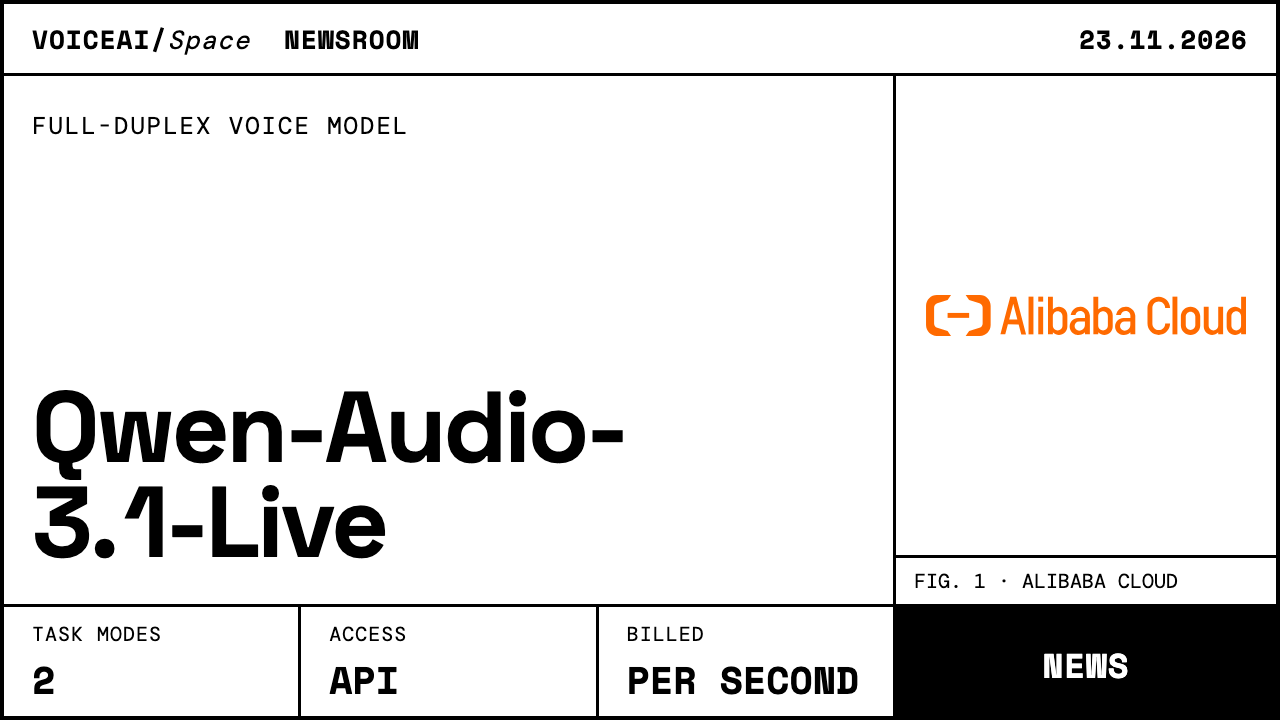
Alibaba Cloud released Qwen-Audio-3.1-Live in its Model Studio platform on November 23, 2026. It is a full-duplex speech-to-speech service: the voice model keeps talking with the user while the application or a backend model works on a task, and announces the result when it is ready. The ID qwen-audio-3.1-live selects the service, and developers pick the foreground voice model separately (qwen-audio-4.0-realtime-preview in Alibaba's quickstart). It is available through the API only and billed per second of session time, at $0.000710 a second in Singapore.
TL;DR
Release: November 23, 2026, listed in Alibaba Cloud Model Studio's release notes and the QwenCloud changelog.
Model IDs: qwen-audio-3.1-live selects the service. The foreground model that talks with the user is set separately: qwen-audio-4.0-realtime-preview or qwen-audio-3.1-realtime-flash.
What it does: real-time, full-duplex voice conversation that continues while a background task runs.
Two modes: Client mode, where the application runs the task, and Responses mode, where Model Studio calls a backend model the developer names.
Price: $0.000710 a second in Singapore and $0.000471 in China (Beijing), billed on session duration. Backend model usage is billed separately.
Not in the Live documentation: benchmarks, a list of supported languages and latency figures. No open weights are mentioned.
What is Qwen-Audio-3.1-Live?
Qwen-Audio-3.1-Live is a voice service in Alibaba Cloud Model Studio, listed in the speech-to-speech category as "real-time full-duplex speech conversation" with support for delegating background tasks.
The model takes text and audio as input and returns text and audio. It supports function calling, so it can connect to business tools. Alibaba's model page lists what it does not support: built-in web search, structured output, prefix completion, context caching, batch inference and fine-tuning. System instructions and function definitions for the voice model are capped at 65,536 tokens combined. Alibaba says a session has no duration limit, and up to 5 WebSocket connections can be open at the same time.
Two IDs are involved. qwen-audio-3.1-live, in the connection URL, selects the service. The session.model setting selects the foreground model that talks with the user. Alibaba's quickstart uses qwen-audio-4.0-realtime-preview with duplex turn detection, so the model keeps listening while it replies, and the API reference also lists qwen-audio-3.1-realtime-flash as an option.
How does Qwen-Audio-3.1-Live delegate tasks?
Qwen-Audio-3.1-Live splits the work between a foreground voice model, which stays in the conversation, and a task that runs in the background. The voice model keeps talking with the user while the task runs and announces the result when it is ready. There are two ways to run the task:
Client mode: the application receives a delegation event and calls its own systems. It can then send a progress update, which the voice model does not announce, an instruction to ask the user a follow-up question, or a result for the voice model to announce. The application can check or filter a result before it is spoken.
Responses mode: Model Studio calls a backend model the developer names, with optional instructions and tools. Alibaba's example uses qwen4-max. Model Studio adds no built-in prompt for the backend model.
Alibaba's worked example: a user asks for the total price of 13 items at 327 CNY each, the backend model computes it, and the voice model announces 4,251 CNY. The explainer How Voice Agents Use Tools Mid-Call covers how voice agents call tools during a conversation.
The design is similar to what Microsoft calls Adaptive intelligence in MAI Realtime 1: a fast system keeps the conversation going and calls a more powerful reasoning engine when a task needs it, with reasoning billed separately.
What does Qwen-Audio-3.1-Live cost?
Qwen-Audio-3.1-Live is billed on session duration: $0.000710 a second in Singapore and $0.000471 a second in China (Beijing). That works out to about $0.043 and $0.028 a minute. Text, silence and idle time inside a session all count, and each session is billed for at least 3 seconds. Backend model usage in Responses mode is billed separately. Alibaba lists a free quota of 36,000 seconds (10 hours) in Singapore, valid for 90 days from activation, release or approval, whichever comes last.
Two related Qwen realtime models are billed per token instead:
Model | Released | Billing | Singapore price |
|---|---|---|---|
qwen-audio-3.1-live | November 23, 2026 | Per second of session | $0.000710 a second |
qwen-audio-3.1-realtime-plus | September 20, 2026 | Per million tokens | Audio input $6.4, audio output $24 |
qwen-audio-3.1-realtime-flash | October 27, 2026 | Per million tokens | Audio input $0.93, audio output $1.87 |
Prices and dates from Alibaba Cloud Model Studio's pricing page and release notes, checked November 29, 2026. Per-second and per-token prices cannot be compared directly.
How do developers connect to Qwen-Audio-3.1-Live?
Qwen-Audio-3.1-Live runs over a WebSocket on a workspace-specific Model Studio domain. The quickstart endpoint is in Singapore (ap-southeast-1), and the session can also use WebRTC or AOQ transport. In the WebSocket quickstart, audio goes in as 16 kHz, 16-bit mono PCM and comes back as 24 kHz mono PCM. Model Studio reports cumulative usage in seconds every 5 seconds during a session.
Qwen Cloud's Try AI playground has demos of the Qwen voices. It opens on the text-to-speech demo, not on the Live service.
Other full-duplex models covered on Voice AI Space include Boson AI's Higgs Realtime Duplex and Block's Dessa.
What the Qwen-Audio-3.1-Live documentation does not include
Quality or latency results for the Live service.
A list of supported languages. Alibaba says the Qwen-Audio-3.1 Realtime model, one of the foreground options for Live, supports 53 languages and 6 Chinese dialects. The Live documentation itself lists no supported languages.
A preview or general availability label for the Live service. The preview label appears only in the foreground model ID, qwen-audio-4.0-realtime-preview.
Related
Microsoft launches MAI Realtime 1, a $0.01-a-minute speech-to-speech model
Boson AI announces Higgs Realtime Duplex, a 45B full-duplex omni model
Looking for a speech-to-speech model for a voice agent? Compare companies in the Voice AI Space Library.
Sources
Alibaba Cloud Model Studio, "qwen-audio-3.1-live", model page, updated November 23, 2026: https://www.alibabacloud.com/help/en/model-studio/qwen-audio-3-1-live
Alibaba Cloud Model Studio, "Qwen-Audio-Live" user guide, accessed November 29, 2026: https://www.alibabacloud.com/help/en/model-studio/qwen-audio-live
Alibaba Cloud Model Studio, Qwen-Audio-Live client events reference, accessed November 29, 2026: https://www.alibabacloud.com/help/en/model-studio/qwen-audio-live-client-events
QwenCloud, model changelog, November 23, 2026 entry, accessed November 29, 2026: https://docs.qwencloud.com/changelog/models
Alibaba Cloud Model Studio, "Model releases and updates", accessed November 29, 2026: https://www.alibabacloud.com/help/en/model-studio/newly-released-models
Alibaba Cloud Model Studio, model pricing, accessed November 29, 2026: https://www.alibabacloud.com/help/en/model-studio/model-pricing
Alibaba Cloud Model Studio, models list, accessed November 29, 2026: https://www.alibabacloud.com/help/en/model-studio/models
Alibaba Cloud Global, LinkedIn post on Qwen-Audio-3.1 multilingual capabilities, November 27, 2026: https://www.linkedin.com/posts/alibabacloudglobal_new-multilingual-capabilities-are-here-activity-7532032793888096258-ufrj
Microsoft AI, "MAI Realtime 1: Leading voice AI at $0.01 per audio minute", November 17, 2026: https://microsoft.ai/news/introducing-mai-realtime-1/