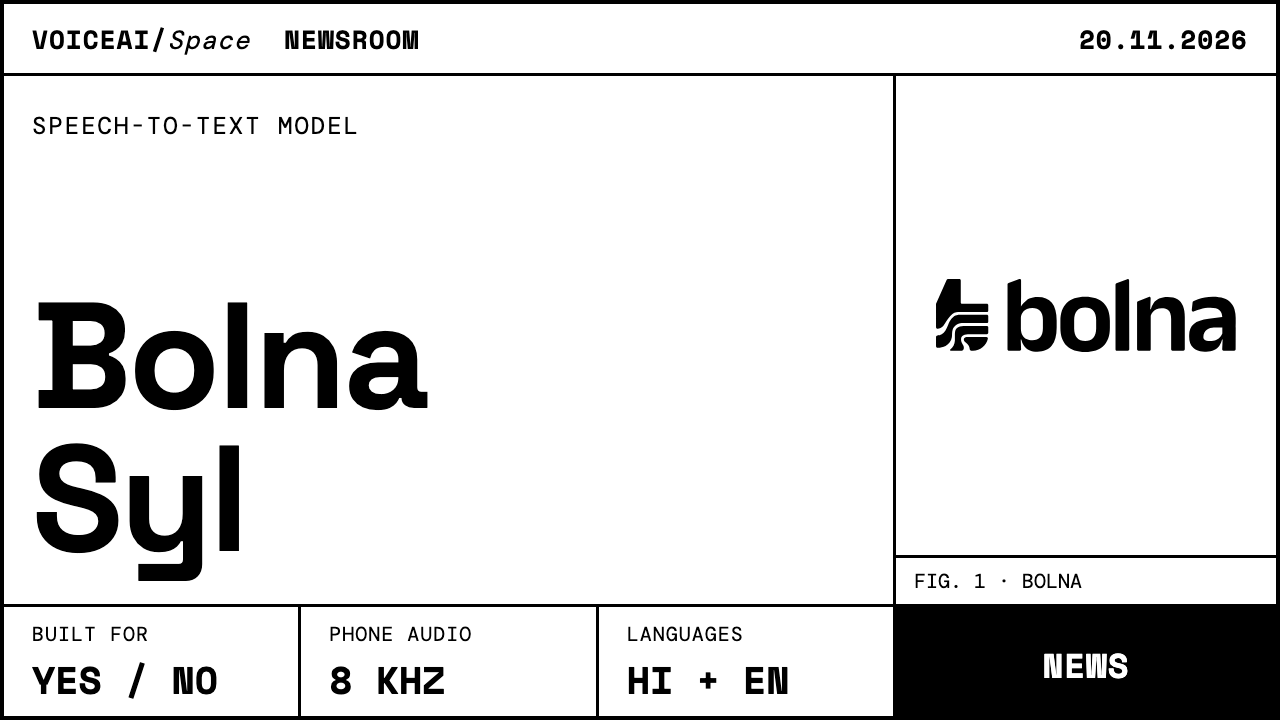
Bolna launched Syl on November 20, 2026, a speech recognition model it built for the shortest replies on a phone call: "yes", "no", "ok", "haan", "nahi", "theek hai". On held-out calls from its own platform, Bolna reports that Syl transcribes 93% of one-word yes/no replies correctly, with a median of 250 ms from the end of a reply to its transcript. All of Bolna's figures come from its own calls. It has not published a public benchmark, the models it compared Syl against, or a price.
TL;DR
Launch: November 20, 2026, at Symphony, Bolna's voice AI event in Bengaluru.
Problem: Bolna says 6 in 10 caller replies are 3 words or fewer, and that about 1 in 10 short replies on its calls came back as an empty transcript.
Results, per Bolna: 93% of one-word yes/no replies transcribed correctly, 250 ms median latency, and on one live agent, 31% fewer requests to repeat.
Cost: "10x cheaper than current SOTA models", with no price and no models named.
Access: through Bolna's sales team. Syl is not yet listed among the transcribers in Bolna's API docs.
Why are short replies hard for speech-to-text?
Bolna notes that a one-word reply is about half a second of sound, so a speech-to-text model has little audio to work with. Bolna names three conditions on Indian phone calls that make this harder: narrow 8 kHz phone audio, callers on busy streets and weak networks, and callers who switch between Hindi and English mid-sentence, sometimes mid-word.
On a call, a missed reply changes the conversation. In Bolna's words, a missed "yes" means a repeated question, or a lost call. Bolna says 6 in 10 caller replies are 3 words or fewer, that about 1 in 10 short replies on its calls came back empty before Syl, and that more than 4 million calls a month on Bolna include short replies. Bolna CTO Prateek Sachan told Analytics India Magazine that a short reply can also carry intent beyond the word itself: "It means an acknowledgement. It might also mean that I'm asking you to stop so that I can speak." Bolna lists turn detection among Syl's tests (more in the explainer on turn-taking in voice AI).
For the common ways transcription fails on calls, see the explainers on why speech-to-text gets it wrong and noise and echo in voice agents.
What is Syl?
Syl is Bolna's first in-house model. The name comes from "syllable", because Bolna built it for replies shorter than one. Bolna runs a platform for voice agents that make and answer phone calls in Indian languages, and according to Analytics India Magazine it has so far built that platform on models from other companies. Its API docs list 11 speech recognition providers for agents, including Deepgram, Sarvam (Saaras v4), Soniox and Gemini.
Syl was not trained from scratch. According to Analytics India Magazine, Bolna fine-tuned an open-source foundation model on its own conversational data, with a focus on short utterances. The same report says the first version targets English and Hindi, and that Bolna plans to add other languages, including Tamil.
Bolna lists three tests Syl had to pass before launch:
Evaluations on word error rate (WER), accuracy in noise (SNR) and turn detection, so that a gain on one did not cost another.
Held-out calls from voice agents already in production on Bolna, not studio recordings.
Short replies, noisy lines and mixed languages, plus a live run on an agent Syl was not trained on.
What results does Bolna report for Syl?
Metric |
Bolna's figure |
Where Bolna measured it |
|---|---|---|
One-word yes/no replies transcribed correctly |
93% |
Held-out production calls |
Median time from end of reply to transcript |
250 ms |
Held-out production calls |
Times the agent asked callers to repeat |
31% fewer |
One production agent Syl was not trained on |
Times callers repeated themselves |
47% fewer |
Same agent |
Cost |
"10x cheaper than current SOTA models" |
No price or models named |
All figures are Bolna's own, from its Syl product page and its November 20, 2026 press release. No independent benchmark has been published.
The 250 ms figure covers the speech recognition step only, from the end of the caller's reply to the transcript. The time before an agent answers also includes the language model and speech synthesis; the explainer on voice AI latency breaks this down.
How can teams use Syl?
Bolna's product page says Syl is "live today" and asks teams to book a demo, after which Bolna sets it up on their agents. As of November 23, 2026, the transcriber list in Bolna's API docs does not include Syl, and the November 2026 changelog does not mention it.
Bolna does not present Syl as a replacement for the other models on its platform. "I don't think our model will be the best in every single use case," Sachan told Analytics India Magazine, adding that Bolna will keep picking the model combination for each language, use case and customer.
What comes next for Syl?
Bolna says it will make Syl context-aware and use-case-aware and extend it to more languages. Syl is the first in a planned family of Bolna models across speech recognition, language models, text-to-speech and decision-making, with models for understanding and speaking expected by the end of 2026, according to Bolna's press release.
What has Bolna not published?
The models behind its comparisons: which "current SOTA models" Syl is 10x cheaper than, and what accuracy those models reach on the same calls.
The size of the test set: how many calls and replies the 93% figure covers.
Scores beyond one-word yes/no replies, and any WER or noise results, although Bolna lists both among its tests.
A breakdown by language. The product page describes Hindi, English and Hinglish calls; Analytics India Magazine reports English and Hindi for the first version.
The open-source model Syl was fine-tuned from.
A price, and whether Syl will be available through the API or to teams outside Bolna's platform.
Related
Sarvam releases Sarvam-105B-1711, the open-weight LLM behind its voice agents and dictation
Soniox launches STT v6 with agent text input and echo cancellation
IBM open-sources Granite Speech 5.0, a 2B speech-to-text model
Looking for a voice agent platform or a speech-to-text provider for Indian languages? Compare companies in the Voice AI Space Library.
Sources
Bolna, "Syl, the ASR model that hears the smallest words", product page, accessed November 23, 2026: https://www.bolna.ai/syl
Bolna, "Bolna's inaugural Symphony brings India's Voice AI ecosystem together, drawing 1,800+ participants in Bengaluru", press release, November 20, 2026: https://www.bolna.ai/newsroom/bolnas-inaugural-symphony-brings-indias-voice-ai-ecosystem-together-drawing-1800-participants-in-bengaluru
Analytics India Magazine, "Bolna Builds Its Own Speech Model to Catch What Voice AI Misses", November 23, 2026: https://analyticsindiamag.com/ai-startups/bolna-builds-its-own-speech-model-to-catch-what-voice-ai-misses
Bolna API docs, "Create agent", transcriber providers, accessed November 23, 2026: https://www.bolna.ai/docs/api-reference/agent/v2/create
Bolna docs, November 2026 changelog, accessed November 23, 2026: https://www.bolna.ai/docs/changelog/november-2026