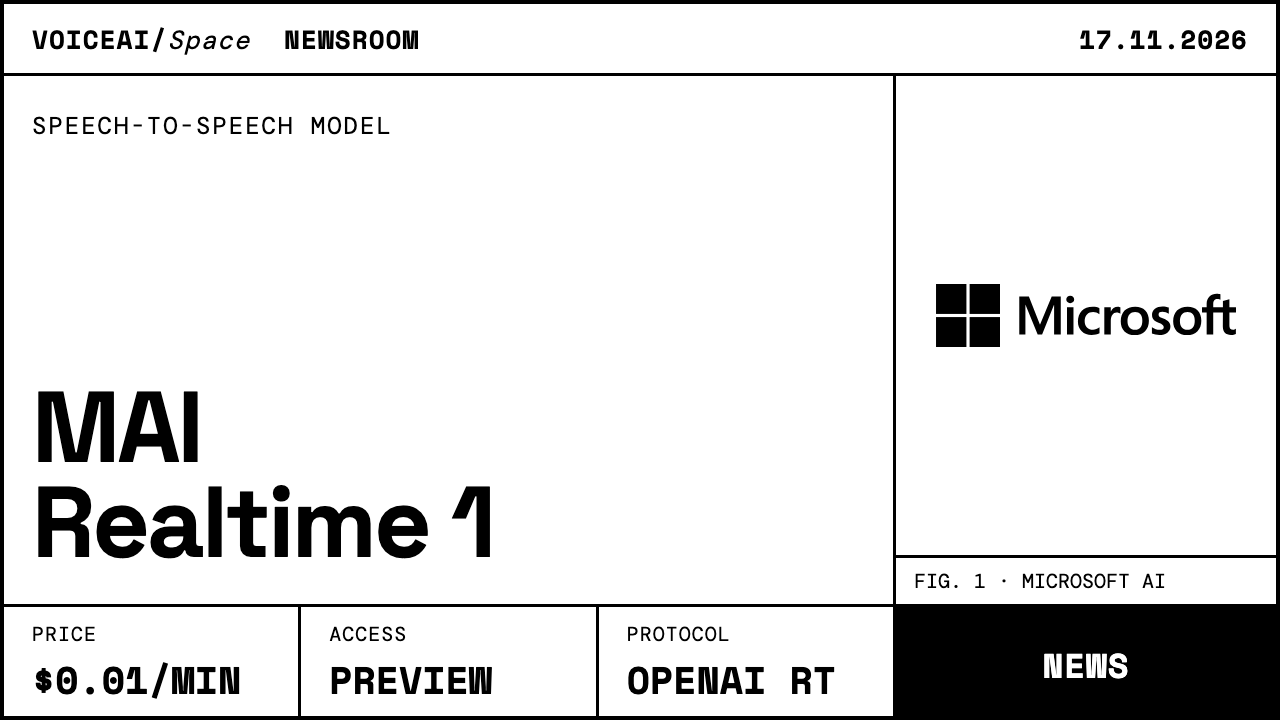
Microsoft launched MAI Realtime 1 on November 17 at Ignite, and describes it as its first speech-to-speech model. It is built for enterprise voice applications, starts at $0.01 per audio minute and is compatible with the OpenAI Realtime API. Access is limited for now: a trial in MAI Labs and a limited-access preview in Microsoft Foundry.
TL;DR
- Model: speech-to-speech, from Microsoft AI (MAI), one of seven models announced at Ignite.
- Price: $0.01 per audio minute for base speech-to-speech. Reasoning is billed separately at $1 per million input tokens and $5 per million output tokens.
- Protocol: compatible with the OpenAI Realtime API.
- Benchmarks: Microsoft reports 98.9% on Big Bench Audio and 57.5% on τ-Voice, from its internal evaluation. As of November 19, the model is not on the Artificial Analysis leaderboard.
- Availability: MAI Labs, plus a limited-access preview in Foundry with no billing until public preview. No language list, regions or general availability date published.
What is MAI Realtime 1?
MAI Realtime 1 is a speech-to-speech model from Microsoft AI. It was one of seven models Microsoft AI announced at Ignite, alongside new coding, image and cybersecurity models. In speech, it follows MAI-Transcribe-2-Streaming and the MAI-Voice-2.1 text-to-speech models, released on October 1 and covered in the Voice AI Space Week 40 roundup.
Microsoft lists five capabilities:
- Turn-taking: handles interruptions and short acknowledgments, and waits for the speaker to finish.
- Reasoning on demand: a fast system keeps the conversation going and calls a stronger reasoning engine when a request needs it. Reasoning is billed separately.
- Noise handling: recognizes requests with background noise or other people talking.
- Tool use: connects to enterprise systems and tools to act on requests. The explainer How Voice Agents Use Tools Mid-Call covers the pattern.
- Personas: tone, style and behavior set through prompting.
The announcement page includes four audio demos, one of them a dental appointment booking. For how a single speech-to-speech model differs from a cascaded speech-to-text, LLM and text-to-speech pipeline, see Cascaded vs Speech-to-Speech Agents and How Speech-to-Speech AI Models Work.
What does MAI Realtime 1 cost?
Base speech-to-speech usage costs $0.01 per minute. When the model calls its reasoning engine, those tokens cost $1 per million input and $5 per million output. Microsoft does not say whether the per-minute rate counts input audio, output audio or both.
In its benchmark charts, Microsoft puts MAI Realtime 1 at $1.35 per hour of input audio. That figure uses the same normalization as Artificial Analysis: the cost of running a fixed 40-question Big Bench Audio subset, scaled to one hour of input audio. On that basis, Artificial Analysis lists GPT-Realtime-2.1 High at $10.75 per hour.
The same per-minute price point appeared a day earlier in Baseten's Realtime Voice announcement, which Baseten says costs about $0.01 per audio minute on fully used GPUs.
How does MAI Realtime 1 compare?
Microsoft says MAI Realtime 1 outperforms GPT-Realtime-2.1 on quality, speed and price, and sits on the price-performance Pareto frontier for Big Bench Audio (spoken reasoning) and τ-Voice (agentic customer-service tasks). Its charts take competitor figures from Artificial Analysis and MAI Realtime 1 figures from Microsoft's internal evaluation, so the rows below do not come from the same test run.
Model |
Big Bench Audio |
Cost per hour of input audio |
Source |
|---|---|---|---|
MAI Realtime 1 |
98.9% |
$1.35 |
Microsoft, internal evaluation |
GPT-Realtime-2.1 High (OpenAI) |
95.8% |
$10.75 |
Artificial Analysis |
Gemini 3.8 Live (Google) |
91.7% |
$0.84 |
Artificial Analysis |
Gemini 3.8 Live Extended Thinking (High) (Google) |
97.7% |
$3.50 |
Artificial Analysis |
Eleven Realtime v1 Max (ElevenLabs) |
98.8% |
$4.80 |
Artificial Analysis |
Competitor figures checked against the Artificial Analysis speech-to-speech leaderboard on November 19. MAI Realtime 1 figures as published by Microsoft on November 17.
The Artificial Analysis board also lists Qwen Audio 3.0 Realtime Plus at 99.2% ($4.42 per hour) and Phonic 1 (High) at 98.9% ($4.20 per hour). Neither is in Microsoft's Big Bench Audio chart.
On τ-Voice, Microsoft's chart shows MAI Realtime 1 at 57.5% and GPT-Realtime-2.1 High at 45.7%. Five models in the same chart score higher than MAI Realtime 1, all at a higher cost per hour, led by Phonic 1 (High) at 79.9%. The competitor τ-Voice figures in Microsoft's chart match the original τ-Voice results on Artificial Analysis. The headline score on Artificial Analysis now uses τ-Voice 2.0, where GPT-Realtime-2.1 High scores 35.8% and Phonic 1 (High) 85.6%. Microsoft does not say which version its 57.5% for MAI Realtime 1 is based on.
Where can teams use MAI Realtime 1?
There are two routes today: MAI Labs, where the model can be tried directly, and a limited-access preview in Microsoft Foundry that requires registration. Preview customers are not billed until the public preview starts. Microsoft says the OpenAI Realtime API compatibility makes it straightforward to test the model and move existing voice applications over.
According to Microsoft, Agoda and Reservations.ai are testing the model. Microsoft is also bringing it to two of its own products: Dynamics 365 Contact Center, for customer service, and Dragon Copilot, where it will run AI-simulated patient conversations that help nurses practice clinical interactions.
What Microsoft has not published
- Languages: no list of supported languages.
- Regions and dates: no Foundry regions, and no date for public preview or general availability.
- Latency: the speed claim comes without a latency figure for MAI Realtime 1.
- Independent results: as of November 19, MAI Realtime 1 is not listed on the Artificial Analysis speech-to-speech leaderboard. Microsoft's own caveat: "Results reflect specific evaluation configurations and workloads."
Related on Voice AI Space
- Boson AI announces Higgs Realtime Duplex, a 45B full-duplex omni model
- Baseten launches Voice Agent Stack and Realtime Voice in private preview
Sources
- Microsoft AI, "MAI Realtime 1: Leading voice AI at $0.01 per audio minute", November 17: https://microsoft.ai/news/introducing-mai-realtime-1/
- Microsoft AI, "Seven new world-class models at scalable price-performance", November 17: https://microsoft.ai/news/microsoft-ignite-2026/
- Microsoft Foundry model catalog, MAI-Realtime-1: https://ai.azure.com/catalog/models/MAI-Realtime-1
- MAI Labs, MAI Realtime 1: https://labs.microsoft.ai/?model=mai-realtime-1
- Artificial Analysis, Speech to Speech leaderboard, checked November 19: https://artificialanalysis.ai/speech-to-speech