Voice AI Knowledge Hub
Explore our curated collection of tutorials, articles, and resources to master voice AI technology and stay ahead of industry developments.
Noise and Echo in Voice Agents, Explained
Five kinds of noise that break voice agents, from fans to echo, and the clean-up chain: echo cancellation, noise suppression and voice isolation.

How Voice Agents Use Tools Mid-Call
How function calling lets a voice agent act during a call, and three ways to fill the silence while a tool runs: preambles, progress sounds, updates.

How Speech-to-Speech AI Models Work
How one model can hear and speak without a text step: audio codecs, codebooks, the text trick and full-duplex conversation, with Kyutai's Moshi as example.

On-Device Voice AI: What Runs Locally
Why run voice AI on the device (privacy, offline, speed, cost) and which parts fit today: speech-to-text and TTS run locally, the language model is harder.

Speaker Diarization Explained
What speaker diarization is, how it differs from speaker identification, and how it works: the classic VAD, embedding, clustering pipeline vs end-to-end.
Build or Buy a Voice AI Agent?
Four ways to get a phone voice agent: finished agent, platform, open-source framework or your own stack, with the trade-off in control, effort and price.

Is Your AI Voice Agent Legal? 5 Rules
Five rules before your voice agent talks to customers: AI disclosure, recording consent, outbound calls, voice cloning and data privacy, EU and US.

Voice AI Agent Cost Per Minute (2026)
What a phone voice agent costs per minute, bill by bill: phone line, speech-to-text, language model, voice and platform fees, and where caching saves.
How to Test a Voice Agent (2026)
Why voice agents are hard to test, and a layered plan: test each part, run simulated callers, grade calls with an LLM judge, then monitor real calls.

How to Prompt a Voice Agent
Prompting for the ear: short turns, one question at a time, no formatting, numbers and dates said clearly, and handling messy live transcripts.

Why Speech-to-Text Gets It Wrong
Six places speech-to-text fails on calls, from names and numbers to noise, and the fix for each: custom vocabulary, read-backs, validation and more.

How Speech-to-Text Works (2026)
How speech-to-text turns sound into words: spectrograms, the encoder, and three decoding methods (CTC, encoder-decoder, transducer), live vs recorded.

Cascaded vs Speech-to-Speech Agents
Two ways to build a voice agent: a cascaded STT, LLM and TTS pipeline or one speech-to-speech model. What each gains in control, latency and tone.
Turn-Taking in Voice AI, Explained
How voice agents know when to talk: end-of-turn detection beyond silence timers, the cues turn detectors listen for, and handling barge-in.

Voice AI Latency: Where the Time Goes
Where the 800 ms latency budget of a voice agent goes, step by step, and how teams win time back with turn detection, streaming and P95 tracking.

SIP Explained for AI Voice Agents
How a phone call reaches an AI voice agent: SIP, SIP trunks, the call setup script, phone audio limits and DTMF keypad tones.
How WebRTC Works, Explained Simply
What WebRTC is and why voice agents use it: the four steps of a call (signaling, STUN and TURN routing, encryption, audio), explained simply.

How TTS Models Are Trained
Where TTS training data comes from, how much is needed (24 hours to a million hours), how raw audio is cleaned, and how voice cloning fits in.

How Text-to-Speech Works, Step by Step
How text becomes speech: text normalization, letters to phonemes, prosody and the sound wave, plus the newer token and noise-refining models.

How Voice AI Benchmarks Work
What a voice AI benchmark measures and where it misleads: WER leaderboards for speech-to-text, human-judged TTS arenas, and turn-taking tests.

The Voice AI Stack Explained (2026)
The voice AI stack layer by layer: models, plumbing (WebRTC and telephony), open-source frameworks, managed platforms, vertical agents and evals.

How Voice Agents Work: STT, LLM, TTS, WebRTC
How does a voice agent work? The STT, LLM and TTS pipeline, why WebRTC is preferred over WebSockets, and cascaded vs speech-to-speech designs.

I Built a Minimalist AI Note Device
Master hardware assembly and AI integration by building a custom minimalist note-taking device designed to streamline your digital productivity workflow.

BreezeTTS2 - 100% Local Real-Time Voice
Discover how to deploy BreezeTTS2 for lightning-fast, local text-to-speech, achieving professional real-time voice synthesis while maintaining complete data privacy effortlessly.

Voice @ AI Engineer
Learn to build real-time voice applications by mastering low-latency architectures, speech synthesis, and advanced conversational AI integration for modern developers.

100% Local AI Speech to Speech with RAG - Low Latency | Mistral 7B, Faster Whisper ++
Build a low-latency, local speech-to-speech AI using Mistral 7B and Faster Whisper, integrating RAG for private and intelligent voice interactions.

How I cut Voice AI costs by 90% (and so can you) - 15 million calls case study
Discover proven techniques to slash Voice AI costs by ninety percent using insights from a massive fifteen million call study.
Build and Deploy a Full Stack Voice Cloning Platform | Next.js, Prisma
Master full-stack AI development by building an ElevenLabs clone using Next.js 16, self-hosting TTS models, and implementing usage-based Polar billing.
KittenTTS - TTS for the Edge
Explore KittenTTS, a lightweight, CPU-optimized speech synthesis tool under 25MB, perfect for seamless deployment on browsers, mobile, and edge devices.
Building pi-assistant: A Tool-Calling Voice Assistant for Raspberry Pi
Local, privacy-friendly voice assistant for Raspberry Pi that answers questions, reports weather, and controls your smart home.
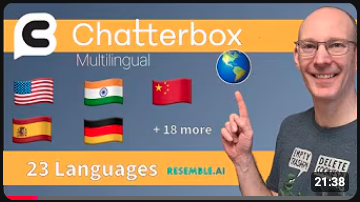
Chatterbox TTS Multilingual | Audio Samples (23 Languages) & Voice Cloning
In this video, Thorsten take a detailed look at Chatterbox TTS, a multilingual text-to-speech system by Resemble AI that runs privacy aware on your local system.

Grok Voice API Demo: Build Voice Agents with xAI & LiveKit
Master rapid integration of Grok’s voice-to-voice API using LiveKit to build responsive agents with emotional range, low latency, and function calling.

Building AI Voice Agents for Production
The course "Building Al Voice Agents for Production" by DeepLearning.Al teaches how to create scalable, responsive Al voice applications using LiveKit.

Building a Voice Archive Search Tool.
Build an audio archive search tool using Deepgram STT, Cohere embeddings, and Pinecone to enable fast, semantic audio transcript retrieval.

Python AI Voice Agent Tutorial - Full Developer Guide (Deepgram, Twilio, Function Calling)
Learn how to build, configure, and deploy a Python AI voice agent with Deepgram and Twilio, including real function calling.
Build a Voice Assistant with Conversational AI on a Raspberry Pi
In this tutorial you will learn how to build a voice assistant with Conversational Al running on a Raspberry Pi.