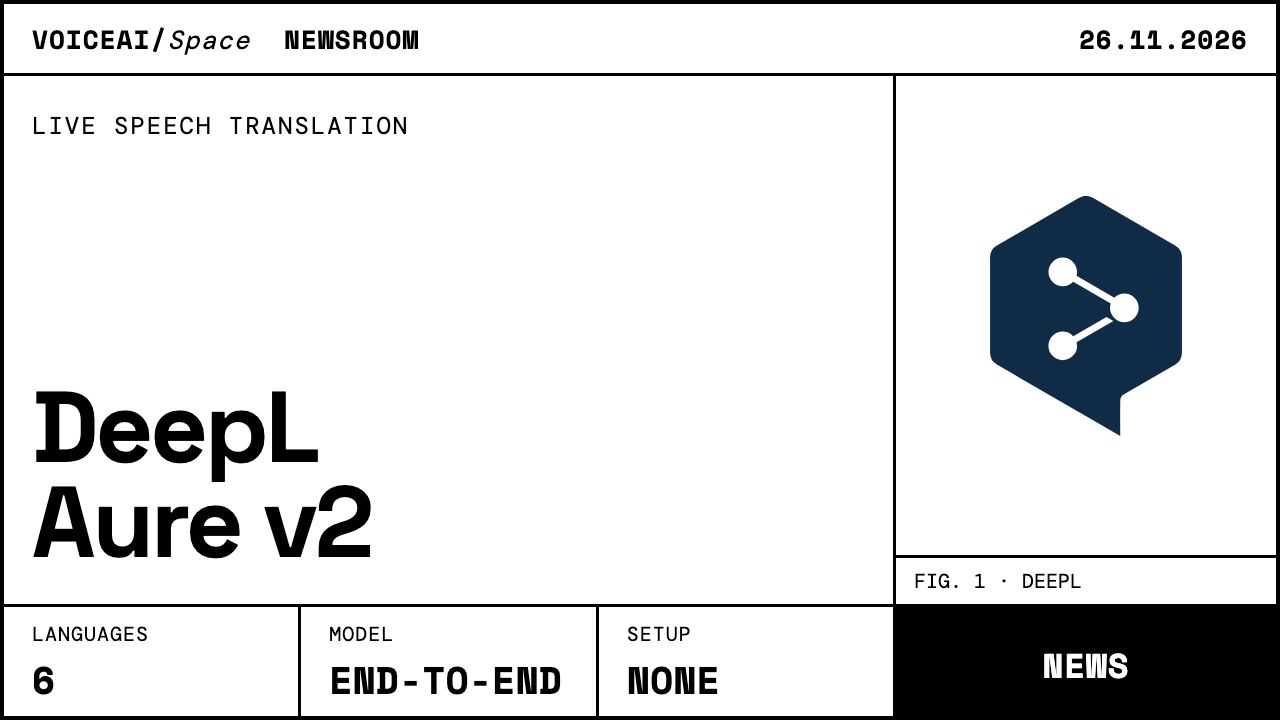
DeepL launched Aure v2 on November 26, 2026, at its first Unmute Summit in Tokyo. Aure v2 is a live voice translation model that goes directly from speech to speech, with no separate transcription, translation and voice steps. DeepL says it halves the median translation delay of Aure, the model it released on November 11. It works in six languages and is available now to DeepL Voice customers.
TL;DR
Launch: November 26, 2026, at the Unmute Summit in Tokyo. Live in DeepL Voice for Online Meetings, DeepL Voice for In-Person Conversations and the DeepL API for Voice.
Model: end-to-end speech-to-speech translation trained with reinforcement learning. The translated voice keeps the speaker's rhythm, intonation and emphasis.
Speed: 50% lower median delay than Aure, with half of translated words heard within 3.3 seconds, according to a DeepL internal study.
Languages: English, German, French, Spanish, Japanese and Korean, for both the spoken and the translated language. The spoken language has to be selected by hand, since auto-detection is not available yet.
Benchmarks: every quality comparison comes from DeepL's internal study of November 2026, scored with DeepL's own metric. DeepL notes that results may differ in real conversations.
Price: DeepL has published no Aure v2 price. The model switches on automatically for supported languages, with no setup.
What is DeepL Aure v2?
Aure v2 is DeepL's second voice translation model in a month. Aure, announced on November 11, adapts the translated speech to the speaker's tone, emotion, emphasis and pace in eight languages. It was covered in the Voice AI Space Week 46 roundup. Aure v2 keeps that expressive output and changes how the translation is produced.
Live translation usually runs three models in a row: speech-to-text, text translation, then text-to-speech. Each stage waits for the one before it, which adds delay. Aure v2 does the whole job in one model. The explainer Cascaded vs Speech-to-Speech Agents covers the difference between the two designs.
The second change is about timing. A live translator has to decide when to start speaking: too early and it lacks context, too late and the conversation stalls. DeepL says this is hardest in German and Japanese, where essential information can come at the end of a sentence. Recordings of real-time translation with the right timing are scarce, so DeepL trained Aure v2 with reinforcement learning and rewarded translations that were "both accurate and quick to start." CTO Sebastian Enderlein said the key is "knowing when you have enough information to translate accurately."
How fast is Aure v2?
Aure v2 has a 50% lower median translation delay than Aure, according to DeepL's internal study. The product page adds two figures: half of translated words are heard within 3.3 seconds, and over a full minute of continuous speech the delay grows by 0.1 seconds. One section of the same page says delays are cut "by up to 50%". DeepL has not published an absolute median delay for Aure (v1). For where delay builds up in a voice pipeline, see Voice AI Latency: Where the Time Goes.
How does Aure v2 compare with other live translation systems?
DeepL's comparisons all come from its own November 2026 study. DeepL reports that Aure v2:
had higher translation quality than six competing systems tested, in every language pair;
made 32% fewer English-Japanese translation errors than Google Gemini 3.5 Live Translate (the product page says the figure covers both directions of the pair);
made 76% fewer critical translation errors than platform-native translation tools in online meetings. This figure appears on the product page only, and DeepL does not name the tools.
DeepL describes the method as follows. The test used 1-minute real-speech recordings across 10 language pairs, with human-validated transcripts, and every model was called over its public API with no app overhead. Errors were counted with TQE (translation quality evaluation), DeepL's in-house metric, in which an AI reviewer checks each translation against the human transcript. DeepL says its models were never optimized for this score. DeepL's caveat: "Results may differ in real conversations." DeepL's pages cite no third-party evaluation of Aure v2.
The six competing systems in DeepL's chart are Microsoft Azure AI Speech Live Interpreter, Google Gemini 3.5 Live Translate (Preview), OpenAI GPT-Realtime-Translate, ElevenLabs Eleven Realtime Translation (Eleven v4 Turbo), Gradium Speech-to-Speech Translation and Krisp AI Voice Translation API. A footnote says ElevenLabs was tested on 8 of the 10 pairs and Gradium on 6.
Company |
Product (as named by DeepL) |
Pairs tested |
Architecture |
|---|---|---|---|
Aure v2 |
10 |
End-to-end |
|
Azure AI Speech Live Interpreter |
10 |
Not stated |
|
Gemini 3.5 Live Translate (Preview) |
10 |
Not stated |
|
GPT-Realtime-Translate |
10 |
Not stated |
|
Eleven Realtime Translation (Eleven v4 Turbo) |
8 |
Chained |
|
Gradium Speech-to-Speech Translation |
6 |
Two models |
|
Krisp AI Voice Translation API |
10 |
Chained |
Architecture as described in each vendor's own documentation. "Not stated" means the vendor does not say whether its system is end-to-end or chained.
Which languages and products support Aure v2?
Aure v2 supports English, German, French, Spanish, Japanese and Korean. Both the language a person speaks and the language the listener hears must be among these six. Aure works differently: its eight languages are output languages, and the speaker can use any language DeepL Voice supports. With Aure v2 the speaker's language must be selected manually, as language auto-detection is "not yet available." For other languages, DeepL Voice falls back to its earlier voice models. DeepL says more languages are coming.
Aure v2 runs in DeepL Voice for Online Meetings (Microsoft Teams, Zoom and Google Meet), DeepL Voice for In-Person Conversations and the DeepL API for Voice.
On data, DeepL says enterprise audio, transcriptions and translations are not used to train its models, and meeting data is deleted when calls end, subject to customer retention settings. Aure adapts to a speaker's voice during the session without storing a voice profile. DeepL holds ISO 27001 and SOC 2 Type II certifications.
How fast is DeepL Voice growing?
DeepL published these usage figures with the launch, all year over year:
Total voice minutes: up more than 8x in Q3 2026. Translated meeting minutes: up about 7x.
Q3 2026 meeting minutes by country: more than 7x in Japan, 5x in South Korea, and more than 6x in both the US and Germany.
Active DeepL Voice subscriptions with meeting usage, as of October 2026: about 12x in Japan and South Korea combined, 8x in the US and 9x in Germany.
DeepL did not publish the base numbers behind these multiples.
What DeepL has not published
An Aure v2 price. The product page offers a free DeepL Voice trial and a sales contact.
An absolute delay figure for Aure (v1).
How the six systems were chosen.
Related on Voice AI Space
Sony is in the game: Walrus, one model that listens, translates and talks
Microsoft launches MAI Realtime 1, a $0.01-a-minute speech-to-speech model
Sources
DeepL, "DeepL introduces Aure v2, its fastest Voice AI translation model", press release, November 26, 2026: https://www.deepl.com/en/press-release/aure-v2
DeepL, Aure product page, checked November 26, 2026: https://www.deepl.com/en/products/voice/aure
DeepL, Aure (v1) press release, November 11, 2026: https://www.deepl.com/en/press-release/aure-voice-ai-model
Microsoft Learn, "How to use Live Interpreter", checked November 26, 2026: https://learn.microsoft.com/en-us/azure/ai-services/speech-service/how-to-use-live-interpreter
Google AI for Developers, Gemini 3.5 Live Translate (Preview) model page, checked November 26, 2026: https://ai.google.dev/gemini-api/docs/models/gemini-3.5-live-translate-preview
OpenAI API docs, GPT-Realtime-Translate model page, checked November 26, 2026: https://developers.openai.com/api/docs/models/gpt-realtime-translate
ElevenLabs API reference, Realtime Translation, checked November 26, 2026: https://elevenlabs.io/docs/api-reference/realtime-translation/v-1-translation-realtime
Gradium, "Launching Gradium Translate", checked November 26, 2026: https://gradium.ai/blog/launching-gradium-translate
Krisp, Voice Translation API product page, checked November 26, 2026: https://krisp.ai/developers/voice-translation-api/