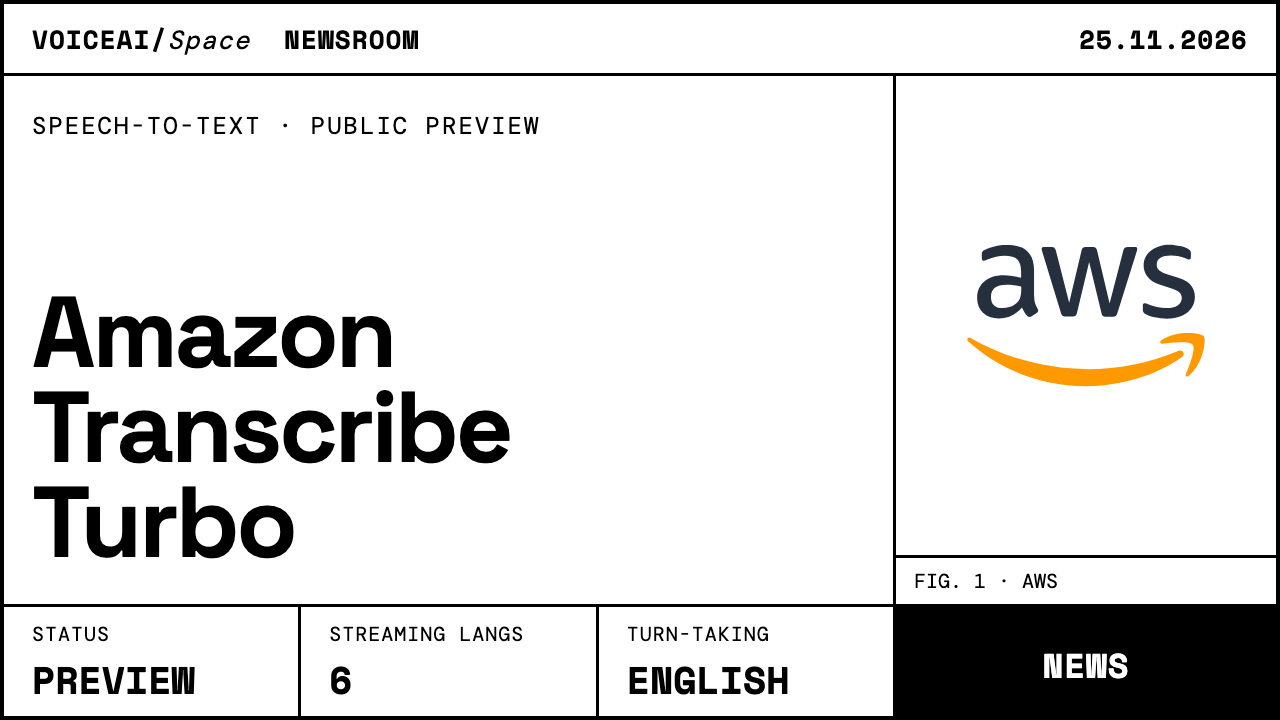
Amazon Web Services put Amazon Transcribe Turbo into public preview on November 25, 2026. AWS calls Turbo its next-generation speech-to-text model, and its streaming version adds two features for voice agents: semantic turn-taking and runtime ASR hints. The preview runs in US East (Ohio) and is meant for test traffic. AWS says Turbo and both features come at no additional charge.
TL;DR
Announced: November 25, 2026, in public preview in US East (Ohio) for batch and streaming. AWS asks users not to send production workloads to the preview.
Streaming accuracy, per AWS: about 14% fewer word errors in English and 11% fewer in Portuguese, French, Italian, German and Spanish, relative to the current production model.
Voice agent features: semantic turn-taking and runtime ASR hints, in English at launch. AWS plans other languages by the end of December 2026.
Turn-taking: AWS reports about 615 ms for turn-taking, with a 5% interruption rate, and says the setting can be tuned.
Price: AWS says Turbo and the two features come at no additional charge. Standard Amazon Transcribe rates vary by Region and tier.
What is Amazon Transcribe Turbo?
Amazon Transcribe Turbo is a new speech-to-text model in Amazon Transcribe, AWS's managed transcription service. AWS says it is built for contact centers, IVR and voice agent applications. According to AWS, the base model needs no API, code or SDK changes. The voice agent features are opt-in and are turned on when a stream starts.
Language coverage depends on the mode:
Streaming: English, Portuguese, French, Italian, German and Spanish, in preview in US East (Ohio).
Batch: English is generally available in most AWS Regions. Portuguese, French, Italian, German, Spanish, Chinese, Japanese, Korean and Arabic are in preview.
AWS plans general availability in more Regions later in December 2026. It also says Speaker Diarization and automatic language identification will be enabled for general availability, without giving a date.
How does Amazon Transcribe Turbo handle turn-taking?
Amazon Transcribe Turbo's semantic turn-taking decides when a caller has finished speaking from what they said and from their prosody, not from silence alone. AWS's getting-started guide describes three events that a voice agent can act on:
EagerEndOfTurnEvent: the caller has probably finished, so the agent can start drafting a reply.TurnResumedEvent: the caller kept talking, so the draft is discarded.EndOfTurnEvent: the turn is over and the agent speaks.
Three settings control the behavior. EndOfTurnThreshold defaults to 0.60, and AWS says raising it reduces interruptions. EagerEndOfTurnThreshold is off by default. EndOfTurnTimeout ends the turn after 5 seconds of silence.
AWS reports about 615 ms for turn-taking, with a 5% interruption rate. It does not say where that timing starts and stops, or which threshold setting produced it. The getting-started guide gives a separate description: replies in under 1 second, with early cut-offs on 2% to 10% of turns depending on the setting. AWS did not name the datasets in these publications. In a voice agent, the language model and speech synthesis add their own time on top of turn detection, as the explainer on voice AI latency breaks down.
What are runtime ASR hints?
Runtime ASR hints let the application tell Amazon Transcribe Turbo what it expects to hear before each turn: menu options, names or an entity type. The client sends them in a ConfigureEvent, and Transcribe confirms each one with a ConfigureAppliedEvent. The guide lists the limits per turn: up to 10 keyword phrases, one entity type out of 10 supported types (such as SERIAL or CURRENCY), and up to 200 inline custom vocabulary phrases. An empty list clears a setting from the previous turn.
AWS says that on English customer service data, hints raise menu-routing accuracy from 87% to 97%.
What results does AWS report?
Metric | AWS figure | Setup AWS gives |
|---|---|---|
Streaming word errors, English | About 14% fewer (relative) | Compared with the current production model; dataset not named |
Streaming word errors, Portuguese, French, Italian, German, Spanish | About 11% fewer (relative) | Same comparison |
Batch word errors, Portuguese, French, Italian, German, Spanish, Arabic | About 16% fewer | Getting-started guide; same comparison |
Batch character errors, Chinese, Japanese, Korean | About 6% fewer | Getting-started guide; character error rate, a separate metric from word error rate |
Numbers, dates, phone numbers and addresses formatted exactly as expected, English | About 78%, up from about 53% | Getting-started guide; the announcement says "more than 20 points" |
Turn-taking | About 615 ms, 5% interruption rate | Timing points, threshold and dataset not named |
Menu routing with hints | 97%, up from 87% | English customer service data |
All figures are AWS's own, from its November 25, 2026 announcement and getting-started guide. The announcement also gives an aggregate figure for batch: about 16% lower word error rate across the nine preview languages, without a per-language breakdown. No independent benchmark has been published.
How does Amazon Transcribe Turbo compare?
Deepgram and AssemblyAI also build end-of-turn detection into their streaming speech-to-text models. Here is what each vendor documents.
Product | End-of-turn events | Languages | Streaming price |
|---|---|---|---|
Amazon Transcribe Turbo (AWS) | EagerEndOfTurnEvent, TurnResumedEvent, EndOfTurnEvent | Turn-taking in English at launch; streaming in 6 languages | No additional charge for Turbo or the features, per AWS; standard Transcribe rates vary by Region and tier |
Flux (Deepgram) | StartOfTurn, Update, EagerEndOfTurn, TurnResumed, EndOfTurn | English model, plus a multilingual model covering 10 languages | $0.0065 a minute for English and $0.0078 for multilingual, pay as you go |
AssemblyAI-STT-3.7-Realtime-Agent (AssemblyAI) | SpeechStarted, then Turn messages with end_of_turn false until a final Turn with end_of_turn true; no eager event | 32 languages | $0.45 an hour of session time |
Each row comes from that vendor's own documentation and pricing page, checked November 29, 2026. No shared benchmark covers all three.
AWS's three turn events follow the same sequence as Deepgram's Flux events, with an Event suffix on the AWS names. Both vendors leave the eager signal off until a threshold is set, and both default to a 5-second silence timeout before forcing the end of a turn. AssemblyAI's documentation says its streaming model "does not endpoint on silence alone" and offers silence thresholds by mode instead of an eager event.
Turbo serves the cascaded setup, where speech-to-text feeds a language model and text-to-speech. AWS also sells a speech-to-speech model, Amazon Nova Sonic, for teams that want one model for the whole exchange. The trade-offs between the two designs are covered in Cascaded vs Speech-to-Speech Agents.
What AWS has not published
The datasets behind the word error, turn-taking and menu-routing figures, where the 615 ms timing starts and stops, and how the 5% interruption rate relates to the 2% to 10% range in the guide.
A Turbo price: the Amazon Transcribe pricing page has no Turbo entry, and AWS says only that Turbo and the features come at no additional charge.
A general availability date for streaming or for the voice agent features. AWS's stated plan is more Regions later in December 2026.
Related
Bolna launches Syl, a speech-to-text model for one-word replies on phone calls
Soniox launches STT v6 with agent text input and echo cancellation
Microsoft launches MAI Realtime 1, a $0.01-a-minute speech-to-speech model
Looking for a speech-to-text provider for a voice agent? Compare companies in the Voice AI Space Library.
Sources
AWS, "Amazon Transcribe Turbo: more accurate transcripts and natural turn-taking for voice agents, now in public preview", November 25, 2026: https://aws.amazon.com/about-aws/whats-new/2026/11/transcribe-turbo-preview/
AWS Builder Center, "Getting Started With Amazon Transcribe Turbo and Voice Agent Features", November 25, 2026: https://builder.aws.com/content/3MbnTQKvOMxTZQbm34D6XV7hv8q/getting-started-with-amazon-transcribe-turbo-and-voice-agent-features
AWS Samples, Amazon Transcribe Turbo voice agent features, sample code: https://github.com/aws-samples/amazon-ai-samples/tree/main/speech-to-text/turbo/features/javascript
Amazon Transcribe pricing, accessed November 29, 2026: https://aws.amazon.com/transcribe/pricing/
Deepgram, Flux docs, turn states, accessed November 29, 2026: https://developers.deepgram.com/docs/flux/state
Deepgram, Flux configuration, accessed November 29, 2026: https://developers.deepgram.com/docs/flux/configuration
Deepgram, models and languages overview, accessed November 29, 2026: https://developers.deepgram.com/docs/models-languages-overview
Deepgram pricing, accessed November 29, 2026: https://deepgram.com/pricing
AssemblyAI, streaming turn detection docs, accessed November 29, 2026: https://www.assemblyai.com/docs/streaming/turn-detection
AssemblyAI pricing, accessed November 29, 2026: https://www.assemblyai.com/pricing