

Qwen Audio
Alibaba Cloud's Qwen speech models: full-duplex real-time voice, speech recognition and synthesis.
About Qwen Audio
Qwen Audio: Real-Time Voice Models on Alibaba Cloud Model Studio
Qwen Audio is Alibaba Cloud's family of speech models on Model Studio, covering real-time speech-to-speech, speech recognition and speech synthesis. Its realtime and live models hold full-duplex voice conversations with text and audio in and out, plus function calling. Qwen-Audio-3.1-Live, released November 23, 2026, keeps talking while a task runs.
Key Features
Qwen-Audio-3.1-Live: A full-duplex voice service that keeps talking with the user while the application or a backend model works on a task, then announces the result. The model ID in the connection URL selects the service, and the session picks the foreground voice model (qwen-audio-4.0-realtime-preview in Alibaba's quickstart, or qwen-audio-3.1-realtime-flash).
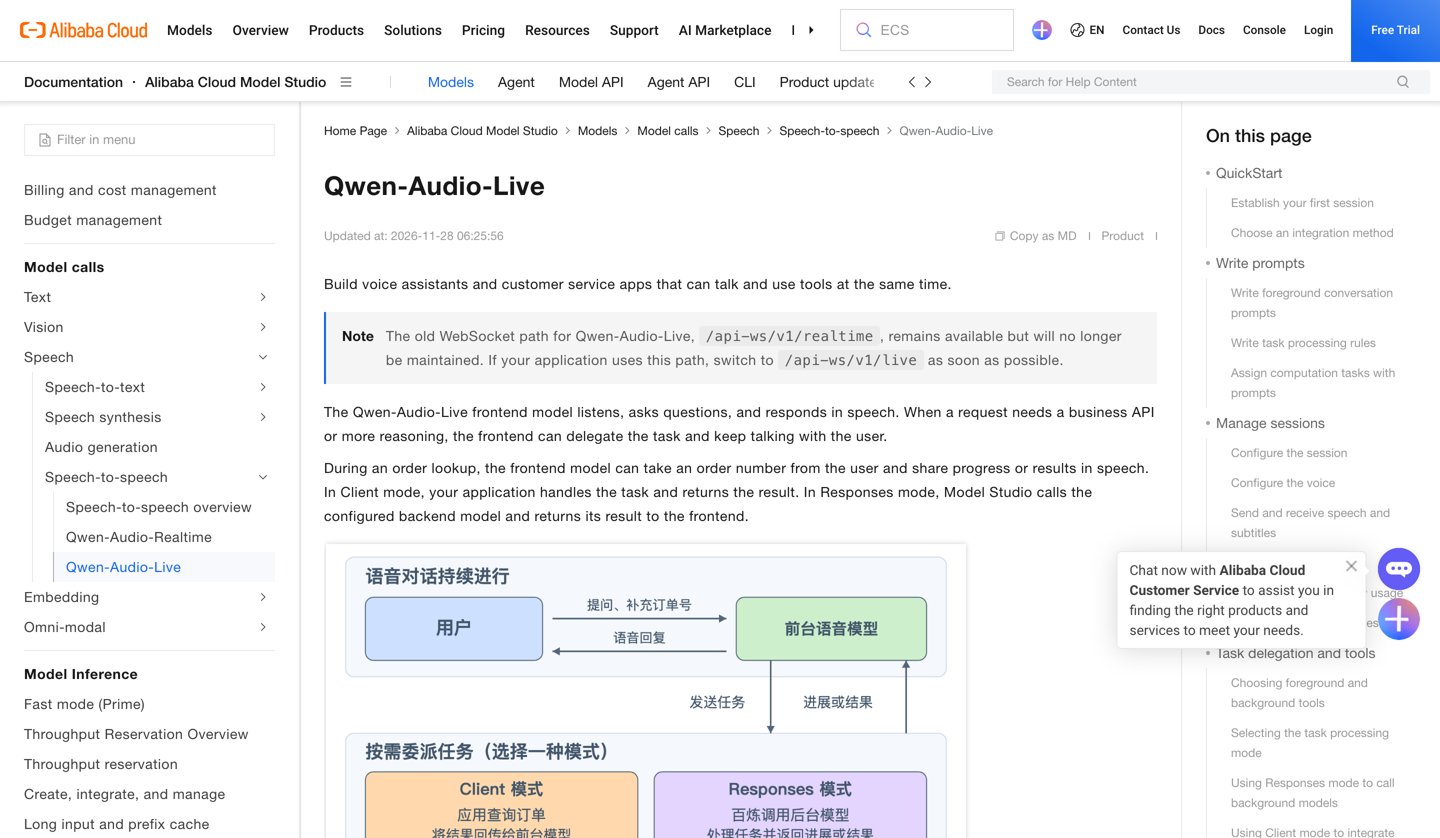
Client and Responses Modes: In Client mode the application receives the delegated task, runs it and returns the result. In Responses mode Model Studio calls a backend model the developer configures. Both modes support function calling for business tools.
Qwen-Audio-3.1-Realtime Plus and Flash: Real-time duplex speech models with text and audio input and output, function calling, web search, voice cloning and a 262,144-token context window. Plus was released September 20, 2026 and Flash October 27, 2026.
Speech Recognition: The qwen-audio-3.1-asr-flash models transcribe real-time and recorded audio, with multilingual and Chinese dialect recognition, hot words and context enhancement, punctuation and text normalization. The file transcription model adds speaker separation.
Speech Synthesis: qwen-audio-3.1-tts-plus and tts-flash generate speech in real time or offline, and tts-next generates voices, sound effects and ambient sound.
Connection Options: Qwen-Audio-Live runs over a WebSocket on a workspace-specific domain, with optional WebRTC for browsers and apps or AOQ for apps using the AOQ Client SDK.
Audio Format: Over a plain WebSocket, input is 16 kHz, 16-bit mono PCM and replies come back as 24 kHz mono audio, with subtitles of the spoken reply.
Regions and Limits: Available in Singapore and China (Beijing). Qwen-Audio-Live allows up to 5 open WebSocket connections at a time.
Use Cases
Customer Service: Voice agents that take an order number, look it up through a business API and announce the result.
Voice Assistants: Assistants that talk and use tools at the same time.
Transcription: Meeting transcription, content production and call analysis from recorded audio.
Speech Generation: Audiobook reading, voice broadcasting and virtual humans.
Pricing
Qwen-Audio-3.1-Live is billed per second of session: $0.000710 a second in Singapore and $0.000471 in China (Beijing), with at least 3 seconds per session. Backend model usage is billed separately. The realtime models are billed per million tokens; in Singapore, Qwen-Audio-3.1-Realtime-Flash costs $0.93 for audio input and $1.87 for audio output. New users get a free quota in Singapore, valid for 90 days.
Getting Started
Website: https://www.alibabacloud.com/help/en/model-studio/qwen-audio-live
Model details: https://www.alibabacloud.com/help/en/model-studio/qwen-audio-3-1-live
Pricing: https://www.alibabacloud.com/help/en/model-studio/model-pricing
Qwen Audio models are available through the Alibaba Cloud Model Studio API, using an API key and workspace ID from the matching region.


