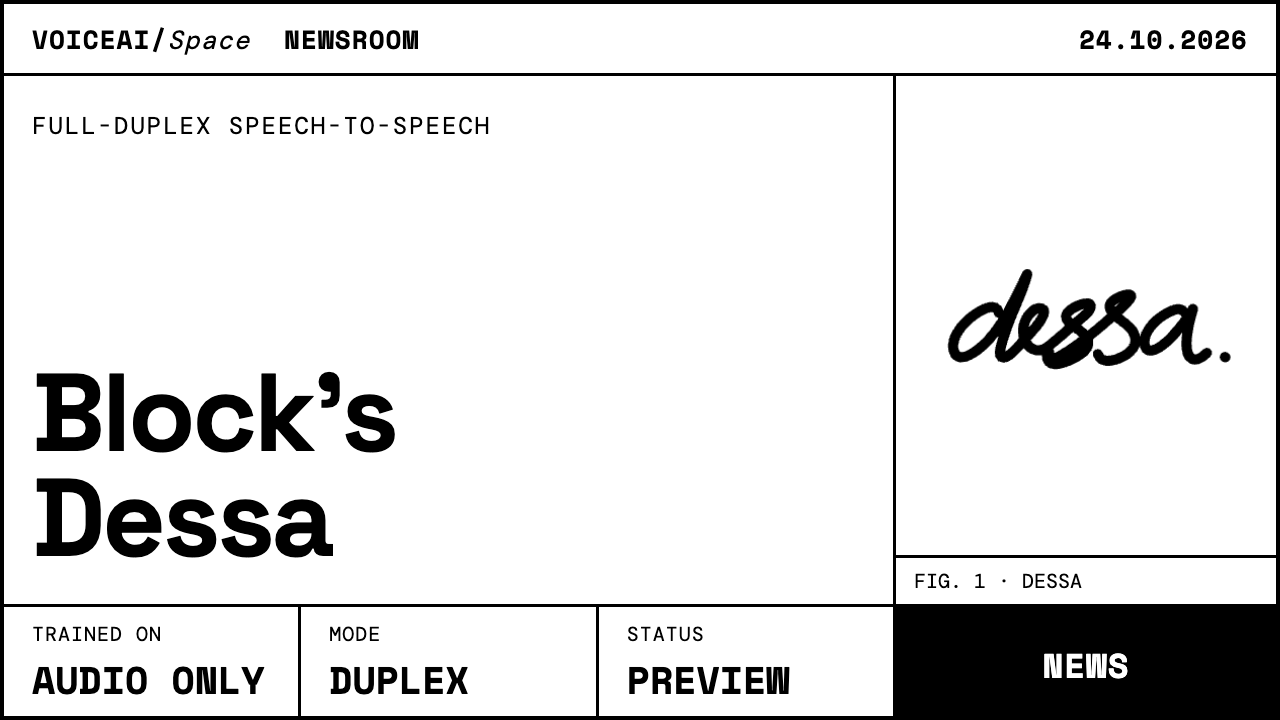
Block has released Dessa, a full-duplex speech-to-speech model trained only on recordings of human conversation, with no text and no pretrained models. The company's AI research lab announced it on October 23 as a research preview: there is a public waitlist, and a small group of AI safety researchers gets early access.
What: Dessa, a full-duplex speech-to-speech conversation model from Block's AI research lab.
Training data: human conversation audio only. Block says it used no text and no pretrained models.
Compute: trained on a single NVIDIA GB200 NVL72 system.
Runs on: a MacBook Pro with an M4 Max chip or better, with inference faster than real time.
Availability: research preview. No API, pricing or model weights announced.
What is Dessa?
Dessa is a speech-to-speech model: audio goes in, audio comes out. It is full-duplex, so it listens and talks at the same time instead of waiting for the user to finish a turn. According to Block, it learned from real conversations when to cut in and when to backchannel with short cues like "yeah" or "got it".
The lab says the model hears and produces emotion, sarcasm, laughter and sighs, the signals a speech-to-text pipeline drops when it turns a voice into a transcript. In the recordings published on the launch page, Dessa chooses what to say, when to say it and how, including its own voice and personality. The page shows it laughing mid-sentence, finishing a user's sentence when they blank on a movie title, and speaking louder when asked.
One demo puts Dessa in a live conversation with GPT-Live-1, a third-party model. Block notes that GPT-Live-1's developer is not affiliated with it and has not reviewed or endorsed Dessa.
How was it trained?
Block says Dessa was trained from scratch on human conversation audio alone. That makes it different from most speech-to-speech systems, which start from a text language model and add audio on top. The lab says Dessa learned language from "hundreds of times fewer words" than a text LLM needs. It has not published a word count, hours of audio, a parameter count or a paper.
Training ran on one NVIDIA GB200 NVL72, a single rack of 72 Blackwell GPUs. Block also states that inference runs faster than real time and that the model runs locally on a MacBook Pro M4 Max or better.
Who built it?
Dessa comes from a small research lab inside Block, the company behind Square and Cash App. It was founded by former members of Dessa, the Toronto deep learning startup that Square, now Block, acquired in 2020. The lab says it has built generative speech models for more than eight years and reports directly to Jack Dorsey, Block's cofounder and chairman. Ragavan Thurairatnam, cofounder of the original startup, leads the project.
How does Dessa compare?
The closest public reference points are Kyutai's open full-duplex model Moshi and NVIDIA's PersonaPlex, which is built on Moshi.
Dessa |
Moshi |
PersonaPlex-7B-v1 |
|
|---|---|---|---|
Developer |
Block |
||
Full-duplex |
Yes |
Yes |
Yes |
Starting point |
Speech only, no text, no pretrained model |
Text language model backbone (Helium), predicts aligned text tokens before audio |
Moshi architecture and weights |
Size |
Not disclosed |
7B |
7B |
Weights |
Not released |
CC-BY 4.0 |
NVIDIA Open Model License |
Runs on |
MacBook Pro M4 Max or better |
NVIDIA GPUs, Apple Silicon via MLX |
GPU, with a CPU offload option |
Status |
Research preview, waitlist |
Open release |
Open release |
Sources: Dessa figures from Block's launch page. Moshi from Kyutai's paper (arXiv 2410.00037) and GitHub repository. PersonaPlex from NVIDIA's GitHub repository and Hugging Face model card. No shared benchmark covers the three models.
What's missing
Block has published recordings but no benchmarks, latency figures, model size, language coverage or technical report. There is no API or download, so outside teams cannot test the model yet. The lab presents the early-access program as a safety step: it wants researchers to look for risks in a model that learned to talk from sound alone.
What it means for teams building voice agents
A cascaded agent turns speech into text, runs a text LLM and synthesises the reply, and Block's argument is that tone and timing are lost in that first step. The VoxParity benchmark points the same way: across 28 voice agents, the median system did no better than a words-only pipeline. Dessa is a test of the opposite approach: skip text entirely and learn conversation from audio. Turn-taking is also moving in the open: the Voice AI Space Week 42 roundup covered NineNineSix's Tyger, an open-weight turn-taking model for full-duplex voice agents. Until Block opens access, it is a research result to watch rather than a component teams can build on. For background, see the Voice AI Space explainer on how speech-to-speech AI models work, and Dessa's page in the Voice AI Space Library.
Sources
Block, "Dessa: the Conversation Model trained only on speech", October 23, 2026: https://block.xyz/dessa
Kyutai, "Moshi: a speech-text foundation model for real-time dialogue", arXiv 2410.00037: https://arxiv.org/abs/2410.00037
Kyutai, Moshi repository: https://github.com/kyutai-labs/moshi
NVIDIA, PersonaPlex repository: https://github.com/NVIDIA/personaplex
NVIDIA, PersonaPlex-7B-v1 model card: https://huggingface.co/nvidia/personaplex-7b-v1
Square, "Welcoming the Dessa Team to Square", February 2020: https://squareup.com/us/en/press/dessa-joins-square