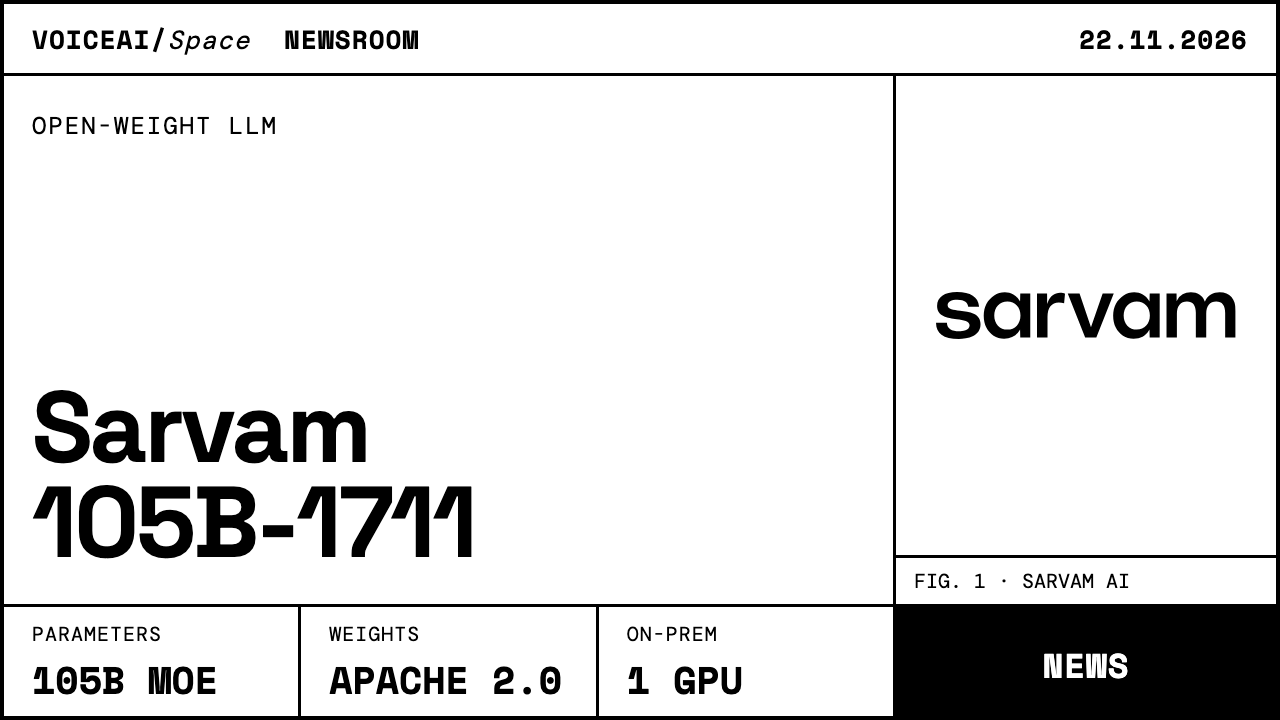
Sarvam AI released Sarvam-105B-1711 on November 22, 2026, a new checkpoint of its 105B mixture-of-experts language model. Sarvam fine-tunes the model to run the voice agents on its Samvaad platform, and pairs it with its Saaras v4 speech recognition model in Sarvam Dictate, a dictation API. The weights are on Hugging Face under Apache 2.0, and Sarvam says a 4-bit build runs on a single workstation GPU.
TL;DR
Release: November 22, 2026, announced in a Sarvam technical blog post.
Voice agents: a voice fine-tune of the model scores 68.7 on Samvaad Bench, Sarvam's own voice-agent benchmark, against 68.0 for Gemma 4 31B and 57.9 for the base checkpoint, according to Sarvam.
Dictation: on 2,959 English dictations, Sarvam reports that Sarvam Dictate needed 5.0% of characters edited, against 8.1% for Gemini 3.5 Transcribe and 10.6% for AssemblyAI Dictation.
Price: ₹10 per million input tokens and ₹25 per million output tokens on Sarvam Token Factory, introductory pricing through the end of 2026.
Weights: a 65 GB NVFP4 checkpoint and a BF16 checkpoint for fine-tuning, both Apache 2.0.
What is Sarvam-105B-1711?
Sarvam-105B-1711 is a new open-weight checkpoint of Sarvam 105B, the mixture-of-experts model Sarvam first released earlier in 2026. Sarvam's docs describe a model with more than 105B total parameters, 128 sparse experts and Multi-head Latent Attention, pretrained on 12 trillion tokens. Sarvam places the new checkpoint in the "Flash-Lite" class of fast, low-cost models and names customer support, voice agents and agentic tasks as its target workloads.
On Sarvam's API, both existing model IDs now run on the new weights, with no code change needed:
sarvam-105b: 128K-token context, reasoning on by default.
sarvam-105b-conversations: a variant post-trained for real-time dialogue and voice agents, with a 32K-token context and reasoning always off.
How does Sarvam-105B-1711 perform on voice agents?
Sarvam-105B-1711 is fine-tuned for voice and deployed in Samvaad, Sarvam's platform for enterprise voice agents in 12 Indian languages. Sarvam lists what the model has to handle on a call: callers who switch languages mid-sentence, revise earlier details or make ambiguous requests, imperfect transcriptions, and unexpected tool outputs, with tool calls made in no-think mode to keep latency low.
Sarvam measures this on Samvaad Bench, a benchmark it built and published on Hugging Face under Apache 2.0. It holds 338 next-turn evaluations taken from real-world scenarios in 13 languages: English and 12 Indian languages, often code-mixed. Each example gives the model the system prompt, the conversation so far and the tools available, and asks for the next action: a spoken reply, a tool call, or both. About half the turns are tool calls with no spoken reply, and most examples come from loan collection and loan sales. An LLM judge checks each response against yes/no rubrics (3,340 in total), code checks verify tool names and arguments, and a turn passes only if every check passes.
Model |
Samvaad Bench, thinking off |
|---|---|
Sarvam-105B-1711, voice fine-tune (NVFP4) |
68.7 |
Gemma 4 31B |
68.0 |
Sarvam-105B-1711 |
57.9 |
Nemotron 3 Super |
43.3 |
All rows are Sarvam's own runs on its own benchmark, published in its November 22, 2026 blog post. The dataset is on Hugging Face.
The blog post also plays six recorded voice-agent calls in English, Hindi, Bengali and Telugu, where Sarvam-105B-1711 and GPT-6 Luna answer the same caller. In these examples, selected by Sarvam, Sarvam-105B-1711 follows the call script, for instance waiting when a caller asks it to hold, or moving on after two unclear answers as the script says, while GPT-6 Luna asks again for consent already given or calls a tool without replying. GPT-6 Luna does not appear in the Samvaad Bench table.
How does Sarvam Dictate use Sarvam-105B-1711?
Sarvam Dictate is a dictation API that takes audio and returns the text the speaker meant to type, in English and 22 Indian languages. One call chains Saaras v4, Sarvam's speech recognition model, with Sarvam 105B, which Sarvam trained with reinforcement learning to turn the raw transcript into finished text: filler words, restarts and self-corrections are removed. Apps can pass up to 1,000 names and terms as a vocabulary. Sarvam says Dictate builds on Kivi, its own dictation app, where people have spoken more than 20 million words.
Sarvam scores dictation with AMEND, a metric that counts the character edits needed to reach what the speaker meant to write. Two judge models count the edits on the same audio for each system.
System |
Price per hour of audio |
Edit rate, English |
Edit rate, Indian languages |
|---|---|---|---|
Sarvam Dictate |
$0.33 |
5.0% |
2.7% |
Gemini 3.5 Transcribe |
$0.31 |
8.1% |
12.2% |
AssemblyAI Dictation |
$0.62 |
10.6% |
11.8% |
Sarvam's results. English: 2,959 real dictations. Indian languages: 692 real dictations in 15 languages; AssemblyAI supports only Hindi, Marathi and Urdu among them, so its score covers 484 dictations. Prices are list rates; for Gemini 3.5 Transcribe, billed per token, Sarvam uses Google's own estimate.
Sarvam also reports that the finished text arrives about half a second after the audio ends, around 3.5 times faster than Gemini 3.5 Transcribe. Dictate is listed at ₹0.5 per minute of audio, with speech recognition and the language model included. For what an edit rate measures and misses, see the explainer on why speech-to-text gets it wrong.
Can Sarvam-105B-1711 run on-premises?
Sarvam-105B-1711 can run on a single NVIDIA RTX PRO 6000 Blackwell workstation GPU, according to Sarvam. The 65 GB NVFP4 checkpoint fits in the card's 96 GB, and Sarvam serves it with vLLM 0.33.0, its DSpark speculative-decoding drafter and an FP8 KV cache. With 500-token replies, Sarvam measured 99 tokens per second for a single user on a 10K-token prompt, and 14 tokens per second per user with four concurrent requests on 50K-token prompts. NVFP4 needs Blackwell's FP4 tensor cores.
Sarvam pitches this setup to banks, hospitals, law firms and government bodies whose data cannot leave the building, and shows Indus Cowork, its co-work agent, reviewing contracts on the card with the network switched off. More on local deployment in the explainer on on-device voice AI.
What else changed in Sarvam-105B-1711?
Sarvam reports that the model's average across eight conversational-agent benchmarks (IFBench, MultiChallenge, Advanced-IF, WritingBench, Arena-Hard v2, Tau2, BFCL v4 and Sarvam's Indic suite) rose from 42.6 for its February release to 73.9. On the same setup, Sarvam reports 74.6 for Qwen3.8 27B, 74.0 for Gemini 3.5 Flash-Lite, 73.0 for Gemma 4 31B and 66.3 for GPT-6 Luna, and plots Sarvam-105B-1711 on the price-performance (Pareto) frontier of the models it tested. The largest gains Sarvam lists are instruction following (IFBench, 32.5 to 82.5), tool use in customer-service conversations (Tau2, 46.2 to 85.5) and Indian languages (Indic suite, 30.1 to 79.1). In Indus, Sarvam's co-work product, the model handles tasks that take dozens of tool calls in a single turn.
Training moved to NVIDIA B200 GPUs. Sarvam reports that 8-bit training doubled pretraining throughput, from 5,500 to 10,900 tokens per second per GPU. In reinforcement learning, 8-bit rollouts plus speculative decoding made generation 2.65 times faster and each training step 1.79 times faster, with the same reward.
What does Sarvam-105B-1711 cost?
Sarvam-105B-1711 costs ₹10 per million input tokens, ₹0.25 per million cached input tokens and ₹25 per million output tokens on Sarvam Token Factory, introductory pricing through the end of 2026. sarvam-105b-conversations has the same rates. Sarvam converts this to a blended $0.15 per million tokens (3 input tokens to 1 output token, at ₹90 per dollar), down from $0.44 for its February release.
Teams that host the model themselves have two Apache 2.0 checkpoints on Hugging Face: the NVFP4 weights, which Sarvam says are the exact model it serves on Token Factory, and BF16 weights for fine-tuning. Sarvam says vLLM support, including DSpark speculative decoding, and NeMo RL post-training support are already merged upstream.
What has Sarvam not published?
Samvaad Bench scores for the closed models in its comparison, GPT-6 Luna and Gemini 3.5 Flash-Lite.
Whether the voice fine-tune scored on Samvaad Bench is available as weights. The Hugging Face releases are the general checkpoint, and the docs do not say whether sarvam-105b-conversations is the same fine-tune.
Related
Looking for a voice agent platform or a speech-to-text provider for Indian languages? Compare companies in the Voice AI Space Library.
Sources
Sarvam, "Introducing Sarvam-105B-1711", technical blog, November 22, 2026: https://www.sarvam.ai/blogs/sarvam-105b-1711
Sarvam API docs, "Sarvam-105B", accessed November 22, 2026: https://docs.sarvam.ai/api/token-factory/models/sarvam-105b
Sarvam API docs, "Dictate API", accessed November 22, 2026: https://docs.sarvam.ai/api/api-guides-tutorials/dictate/overview
Hugging Face, sarvamai/sarvam-105b-1711 (NVFP4, Apache 2.0): https://huggingface.co/sarvamai/sarvam-105b-1711
Hugging Face, sarvamai/sarvam-105b-1711-bf16 (BF16, Apache 2.0): https://huggingface.co/sarvamai/sarvam-105b-1711-bf16
Hugging Face, Samvaad Bench v2.1 dataset (Apache 2.0): https://huggingface.co/datasets/sarvamai/samvaad-bench-v2.1
Sarvam, LinkedIn announcement, November 22, 2026: https://www.linkedin.com/posts/today-were-releasing-sarvam-105b-1711-our-share-7530298560135929857-SEBo/
Sarvam Token Factory API playground (Sarvam account required): https://indus.sarvam.ai/token-factory/api-playground/chat-completions