In partnership with Soniox
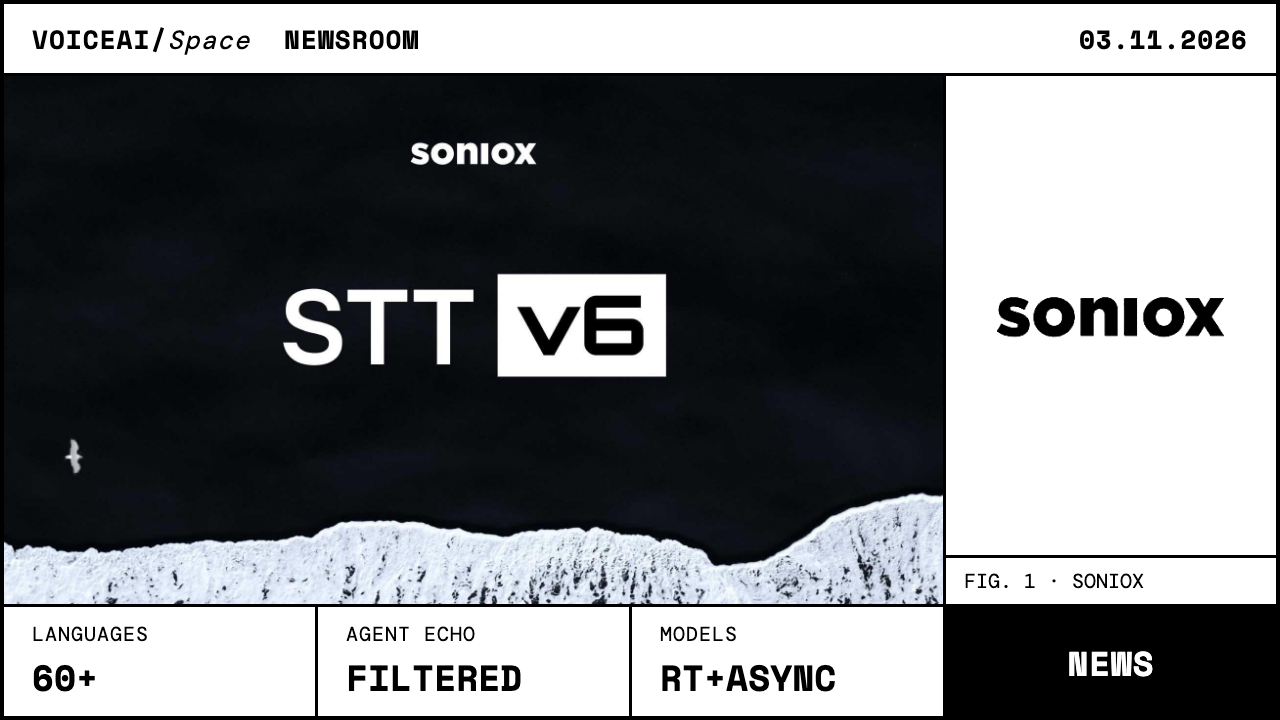
Soniox has launched Soniox STT v6, a speech-to-text model that takes in what a voice agent is saying as well as what the caller says. Soniox says v6 uses the agent's words to recognize the caller's replies more accurately and to filter the agent's own voice out of the transcript, even when the caller interrupts. The release also brings accuracy gains across 60+ languages for voice typing, meeting transcription and real-time translation, according to the company.
Models: v6 comes as a real-time model for live audio and an asynchronous model for recordings.
Agent text input: developers send the agent's words to Soniox while it speaks, so the model knows what the caller is replying to.
Agent voice echo cancellation: v6 uses that text to keep leftover agent playback out of the transcript while still hearing a caller who interrupts.
Languages: both agent features work in every supported language.
Billing: the agent's words are billed at the same rate as other text sent to Soniox.
What is Soniox STT v6?
Soniox STT v6 is the latest generation of Soniox's speech-to-text model, available as a real-time model for live audio and an asynchronous model for recordings. It is one unified model across 60+ languages, so speakers can mix languages, even mid-sentence, without the developer switching models. The previous generation, v5, shipped in June, and Voice AI Space covered v5 Real-Time at the time.
Soniox positions v6 for three uses:
Voice agents: agent text input and agent voice echo cancellation, covered below.
Voice typing: Soniox says v6 is its fastest and most accurate dictation model, with better written rendering of numbers, currencies, units, dates, alphanumeric IDs, names and specialist terms. Text streams while the user speaks and finalizes when they stop.
Meeting products: Soniox lists better transcription and speaker diarization in meetings with rapid speaker changes, interruptions, overlapping voices and language switching. Developers can supply participant names, company terms and project vocabulary as context.
Soniox also lists improvements to spoken language identification, endpoint detection and the use of supplied context. For real-time translation, v6 adjusts how much speech it collects before translating. Soniox says this matters in languages such as German and Korean, where words later in a phrase can change how earlier ones are translated.
How does agent text input work?
In a typical voice agent, speech-to-text hears only the caller. The agent's voice is played to the caller and removed from the microphone by echo cancellation, so the model never hears the question the caller is answering.
With v6, developers switch the feature on when a call starts. While the agent speaks, the app sends its words to Soniox in small pieces, alongside the caller's audio, and marks where each agent turn ends.
The docs give examples where knowing the question changes the result. When the agent has just offered two cafes, "River Roast" is less likely to come out as "River Road." When it has asked what help a stranded driver needs, "a tow" is less likely to come out as "a tour." According to the docs, short answers gain the most, since a word or two of audio gives the model little to go on. The caller's first words, before the agent has said anything, get no help from agent text, and the docs point to context for those. The agent's text never appears in the transcript.
How does agent voice echo cancellation work?
When the agent's voice reaches the microphone, speech recognition can mistake it for the caller. Soniox says this can make an agent interrupt itself, respond to its own words or fall into a feedback loop.
Echo cancellation is never perfect, and Soniox's docs note that parts of the agent's voice often leak through, especially as it starts talking. Because v6 knows what the agent is saying, it can tell that leftover echo apart from the caller and leave it out. The model keeps listening while the agent speaks, so when a caller interrupts, their speech is still recognized.
The docs tell developers to keep their existing echo cancellation on, since agent text input handles what it leaves behind rather than replacing it. Soniox says the result is fewer false interruptions on speakerphones, laptops, in-car systems and other devices where playback reaches the microphone.
For background on the clean-up chain, see the Voice AI Space explainer Noise and Echo in Voice Agents, Explained.
What do developers need to do?
The feature is switched on in the real-time model. According to Soniox's docs, there are three things to get right:
Send the words as they are spoken: the app sends each part of the agent's reply just before the caller hears it, not the whole reply at once.
Stop when the caller interrupts: the app sends only the words the caller actually heard and drops the rest of the reply.
Send speech only: just the words the agent says out loud, without formatting or notes. Background information, such as company or product names, goes into Soniox's separate context setting.
The agent's words are billed like other text sent to Soniox, and only text that reaches the model counts.
Sources
Soniox, "Introducing Soniox STT v6" (announcement text supplied to Voice AI Space)
Soniox Docs, "Agent text input": https://docs.soniox.com/stt/rt/agent-text-input
Soniox, Speech-to-Text API: https://soniox.com/speech-to-text
Soniox Docs, Models and changelog: https://docs.soniox.com/stt/models
Product launch · Published in partnership with Soniox