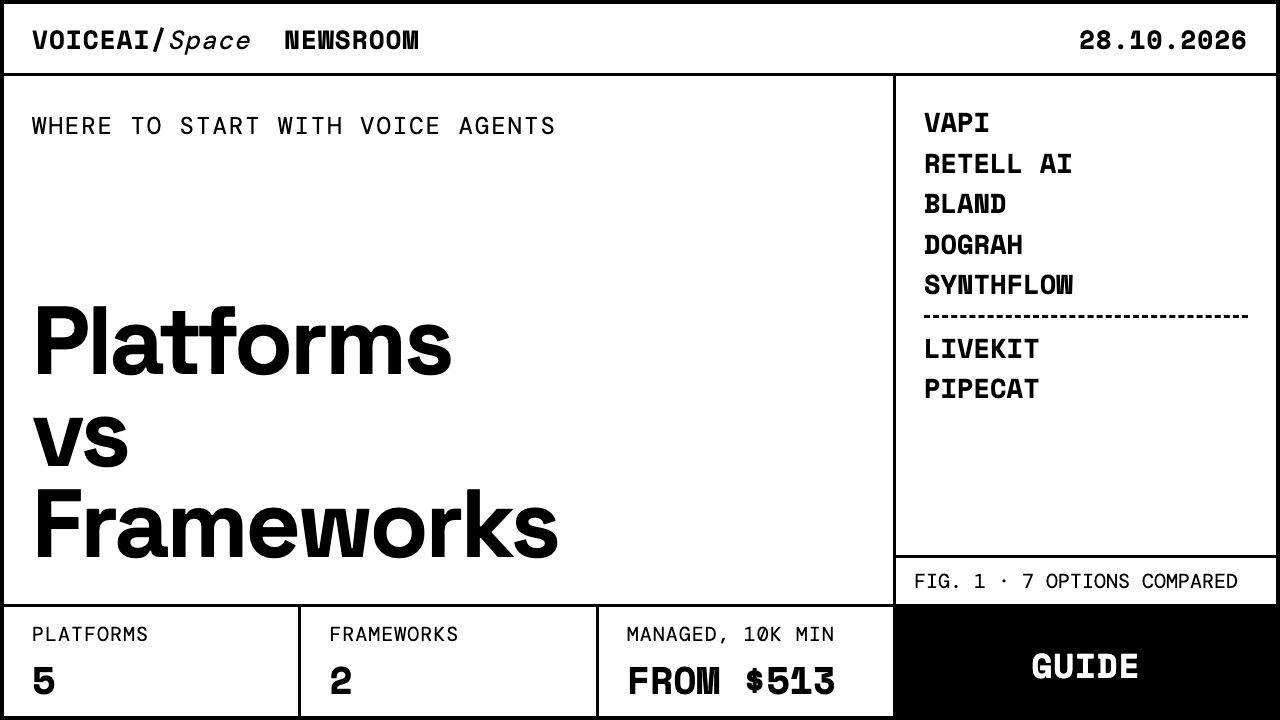
There are two main ways to build a voice agent in 2026. The first is a managed voice agent platform such as Vapi, Retell AI, Bland, Dograh or Synthflow. The second is an open-source code framework such as LiveKit Agents or Pipecat. This guide compares both paths on features, hosting, phone calls and cost per minute. Every price comes from the vendor's own pricing page, checked on October 28.
Updated October 28, 2026.
Managed platforms handle hosting, turn-taking and phone numbers, and you configure the agent in a dashboard or through an API. Platform fees run from $0.01 a minute (Dograh Cloud) to $0.055 (Retell). Bland charges a single rate of $0.14 that includes the models.
Code frameworks are open-source libraries: LiveKit Agents (Apache 2.0) and Pipecat (BSD 2-Clause). You write the agent in Python (LiveKit also supports Node), then self-host it or run it on the vendor's cloud for about $0.01 a minute.
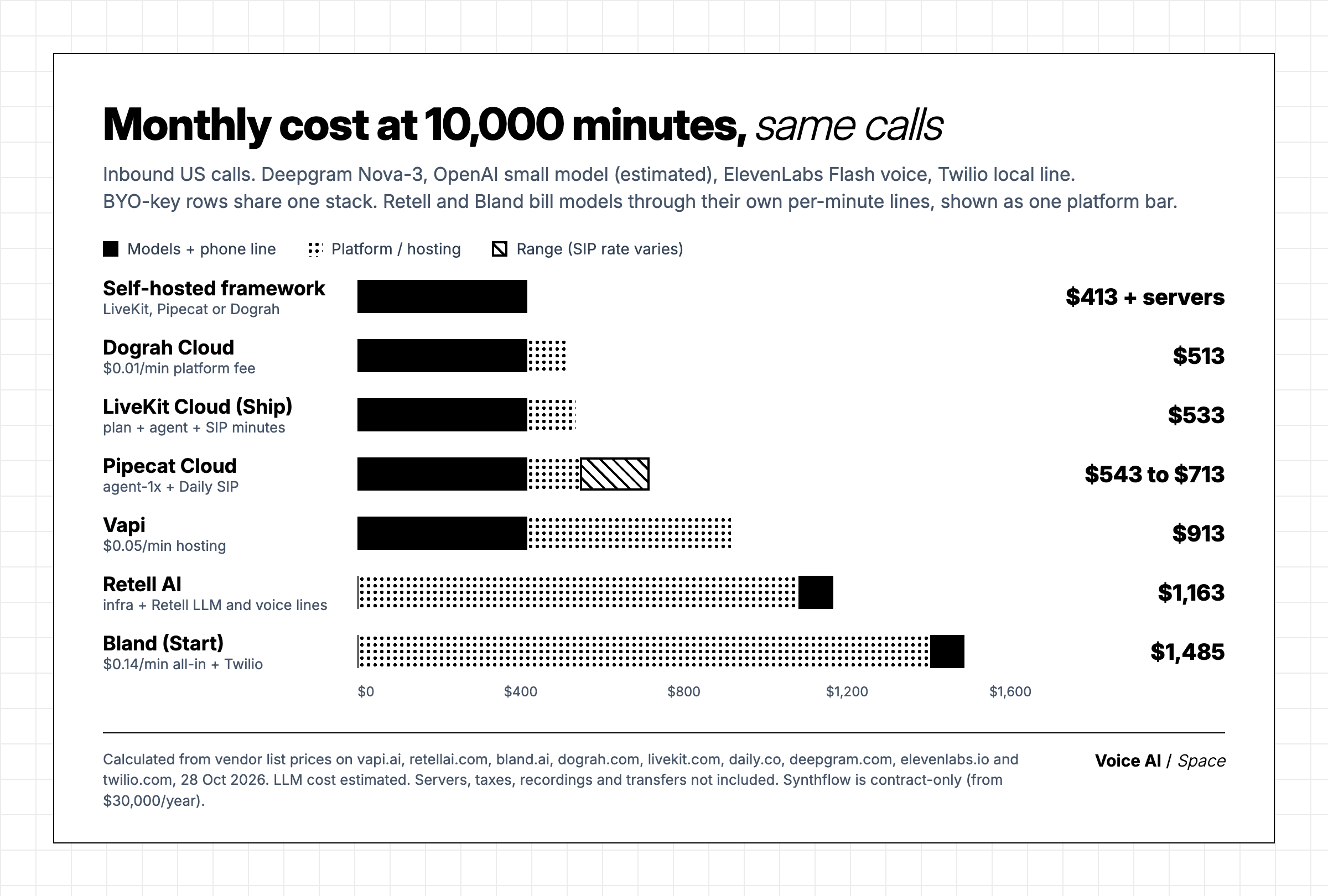
At 10,000 minutes a month on the same speech-to-text, LLM, voice and phone line, the monthly bill in this guide ranges from about $513 (Dograh Cloud) to $1,485 (Bland).
Synthflow is sales-led only, with contracts starting at $30,000 a year.
How this guide compares them
All prices are pay-as-you-go list prices in US dollars. They were taken from each vendor's pricing page on October 28, 2026, and every page is linked in Sources. Some figures are calculated from a vendor's listed rates. When that happens, the text says so and gives the assumption.
To see where these products fit in the wider stack (models, transport, frameworks, platforms and finished vertical agents), watch the four-minute explainer The Voice AI Stack Explained. The trade-off between buying a finished agent, using a platform, using a framework or building your own stack is covered in Build or Buy a Voice AI Agent?.
What does a voice agent need under the hood?
Most production voice agents are cascaded:
Speech-to-text (STT) transcribes the caller.
A language model (LLM) decides the reply.
Text-to-speech (TTS) speaks it.
Around that pipeline sit the transport and the conversation logic:
Transport is WebRTC for apps and browsers, SIP for phone calls.
Turn-taking decides when the caller has finished and handles interruptions.
The alternative is a single speech-to-speech model that hears and speaks without a text step. Every product in this guide supports the cascaded design.
The pipeline is explained step by step in How Voice Agents Work: STT, LLM, TTS, WebRTC.
Platforms and frameworks differ in one way: who builds and runs that middle layer. - A platform runs it for you. You choose the models and write the prompt. - A framework gives you the building blocks in code. You assemble them and decide where they run.
The master comparison
Type |
Open source |
Pricing model |
Free start |
Phone calls |
|
|---|---|---|---|---|---|
Platform |
No |
$0.05/min hosting, models at provider cost or your own keys |
$5 credit |
Vapi numbers, BYO SIP trunk |
|
Platform |
No |
$0.055/min voice infra, plus LLM, voice and phone lines |
$10 credit |
Retell numbers ($2/month), free SIP trunking |
|
Platform |
No |
$0.14/min all-in for LLM, STT and TTS (Start) |
2 credits + inbound number |
Own Twilio account or SIP trunk, or Bland's at pass-through cost |
|
Platform |
Yes, BSD 2-Clause |
Free to self-host; cloud is $0.01/min plus your own keys or Dograh models |
Self-host free; cloud credits from $5 |
Twilio, Vonage, Telnyx, Plivo, Asterisk and others |
|
Platform |
No |
Enterprise contracts from $30,000/year |
None listed |
Native telephony or SIP trunking |
|
Framework |
Yes, Apache 2.0 |
Free to self-host; LiveKit Cloud is $0.01/min after included minutes |
1,000 agent minutes/month |
LiveKit numbers ($0.01/min inbound) or third-party SIP |
|
Framework |
Yes, BSD 2-Clause |
Free to self-host; Pipecat Cloud is $0.01/min per agent |
No free allowance listed |
Daily SIP ($0.003 to $0.02/min) or PSTN ($0.018/min) |
Source: each vendor's pricing page and GitHub repository, October 28, 2026. BYO = bring your own.
No-code and managed platforms
Vapi
Vapi presents itself as a platform for developers building voice agents. Its pricing page lists:
Hosting fee: $0.05 a minute.
Models: passed through at provider cost with no markup. You can also connect your own API keys, in which case Vapi does not bill that provider.
Free start: $5 in credits, 4 concurrent calls and one phone number.
Core package: $29 a month raises the limit to 10 concurrent calls.
Telephony and SIP: free on Vapi's side. Carrier minutes are charged by the carrier, and any SIP provider can be connected as a custom trunk.
Best for: developers who want an API-first platform and full choice of models.
Limits: it is not open source, and the bill grows with every provider you add on top of the hosting fee.
Retell AI
Retell AI focuses on phone agents. On its pricing page:
Voice infrastructure: $0.055 a minute, covering Retell's default speech engine.
Language model: a separate line. GPT 4.1 mini is listed at $0.0128 a minute.
Voice: a separate line. Retell's own voices cost $0.015 a minute and ElevenLabs Flash voices $0.04 (other ElevenLabs models cost $0.06 to $0.10).
Advertised all-in range: $0.07 to $0.31 a minute.
Free start: $10 in credits and 20 concurrent calls. Extra concurrency costs $8 a call per month.
Phone numbers: $2 a month. SIP trunking to your own carrier has no Retell charge.
Best for: teams that want phone agents with fast setup and a large free concurrency allowance.
Limits: it is closed source, and premium voices and frontier LLMs push the per-minute rate toward the top of that range.
Bland
Bland describes itself as an enterprise voice AI platform for phone agents. It charges one rate per minute that includes the LLM, speech-to-text and text-to-speech, with no token charges, according to its pricing page.
Plan |
Per minute |
Platform fee |
Concurrent calls |
Calls per day |
|---|---|---|---|---|
Start |
$0.14 |
None |
10 |
100 |
Build |
$0.12 |
$299 a month |
50 |
2,000 |
Transfers: $0.05 a minute on Start.
Telephony: billed separately, on your own carrier or on Bland's at pass-through cost.
Best for: teams that want one predictable rate and no model bills to manage.
Limits: you get less choice of models than with bring-your-own-key platforms, and the all-in rate is the highest base price in this guide.
Dograh
Dograh is a visual workflow builder for voice agents. It calls itself "the open-source, self-hostable alternative to Vapi & Retell". - License: BSD 2-Clause. The GitHub repository has about 6,000 stars, and the platform runs with Docker Compose. - Bring your own keys: for LLM, STT, TTS and telephony. Supported carriers include Twilio, Vonage, Telnyx, Plivo and Asterisk. - Dograh Cloud: a $0.01 a minute platform fee and 10 concurrent calls, according to its pricing page. You either bring your own keys or use Dograh's models, which are billed by usage. Dograh does not publish those model prices.
Best for: teams that want a no-code builder but need to self-host for data or cost reasons.
Limits: it is younger and smaller than Vapi or Retell, and the per-minute prices of Dograh's own models are not public.
Synthflow
Synthflow now sells through sales only. Its pricing page states that enterprise contracts start at $30,000 a year. Pricing is scoped by call volume, concurrency, telephony setup, integrations and security needs. - Telephony: Synthflow's own telephony, SIP trunking or approved enterprise carriers. - No self-serve option: no per-minute rate or free tier is listed on the live page.
Best for: contact-center buyers who want a vendor-led rollout.
Limits: it is not a starting point for a single developer testing an idea.
Code frameworks
LiveKit Agents
LiveKit Agents is an open-source framework for real-time voice and video agents. It is built on LiveKit's WebRTC media server. - Code: Apache 2.0, with SDKs in Python (livekit/agents, about 15,000 stars) and Node.js. Version 1.8.9 shipped on October 24. - Hosting: self-host everything, or run on LiveKit Cloud.
LiveKit Cloud plan |
Price |
Agent minutes included |
After that |
|---|---|---|---|
Build |
Free |
1,000 |
Not listed |
Ship |
From $50 a month |
5,000 |
$0.01 a minute |
Scale |
From $500 a month |
50,000 |
$0.01 a minute |
Inference: LiveKit Cloud sells STT, LLM and TTS models per minute, for example Deepgram Nova-3 at $0.0048 a minute on Build and Ship.
Telephony: US local numbers are $1 a month (one free) and inbound minutes $0.01. Third-party SIP minutes cost $0.004 on Ship.
Best for: developers who want full control in code, with the option to self-host or run on a managed cloud.
Limits: you write and maintain the agent yourself, with no visual builder.
Pipecat
Pipecat is an open-source Python framework for voice and multimodal agents. Its managed hosting, Pipecat Cloud, is run by Daily. - Code: BSD 2-Clause. The repository has about 16,900 stars, and version 1.14.0 shipped on October 24. - Design: an agent is a pipeline of processors. You swap STT, LLM and TTS providers by changing one service in that pipeline. - Hosting: self-host, or use Pipecat Cloud. Its standard voice agent size (0.5 vCPU, 1 GB) costs $0.01 per active minute. - Transport: Daily WebRTC is free for one-to-one voice sessions on Pipecat Cloud. Daily SIP costs $0.003 to $0.02 a minute and PSTN dial-in and dial-out $0.018.
Best for: Python teams that want a large ecosystem of provider integrations.
Limits: like LiveKit, it is code-first. Pipecat Cloud lists no free allowance or credits.
Other frameworks
TEN Framework, backed by Agora, is another open-source option with about 11,200 GitHub stars. Its license is Apache 2.0 plus extra conditions, including a ban on hosting it on end-user devices and on deployments that compete with Agora. Read the license file before building on it.
How much does a voice agent cost per minute?
A phone voice agent pays up to five bills:
the phone line,
speech-to-text,
the language model,
the voice,
the platform.
The explainer Voice AI Agent Cost Per Minute walks through each one.
This example prices 10,000 minutes a month of inbound US calls on one stack. The stack and its rates:
Bill |
Choice |
Rate |
Source |
|---|---|---|---|
Speech-to-text |
Deepgram Nova-3 streaming |
$0.0048 a minute (limited-time promotional rate; regular price $0.0077) |
Deepgram pricing page |
Language model |
OpenAI small model |
About $0.008 a minute |
Estimate, explained below |
Voice |
ElevenLabs Flash |
About $0.02 per call minute |
Calculated, explained below |
Phone line |
Twilio US local inbound |
$0.0085 a minute |
Twilio pricing page |
Language model. OpenAI bills per token, not per minute, so the per-minute figure is an estimate. Vapi's published range for OpenAI models starts at $0.0077 a minute.
Voice. ElevenLabs Flash costs $0.04 per 1,000 characters, which ElevenLabs equates to about $0.04 per minute of speech. The agent usually speaks for about half the call, so that comes to about $0.02 per call minute.
Without any platform fee, these four lines cost about $0.041 a minute, or $413 a month. Each platform then adds its own fee on top.
Path |
Platform cost at 10,000 min |
Total per month |
Notes |
|---|---|---|---|
Self-hosted LiveKit, Pipecat or Dograh |
$0 + your servers |
$413 + servers |
Servers, a SIP bridge for phone audio and engineering time not included |
Dograh Cloud |
$100 |
about $513 |
$0.01/min platform fee, own keys |
LiveKit Cloud (Ship) |
$120 |
about $533 |
$50 plan, 5,000 extra agent minutes at $0.01, 5,000 SIP minutes at $0.004 |
Pipecat Cloud |
$130 to $300 |
about $543 to $713 |
agent-1x at $0.01/min, plus Daily SIP at $0.003 to $0.02/min |
Vapi |
$500 |
about $913 |
$0.05/min hosting, own keys |
Retell AI |
$550 + Retell's LLM and voice lines |
about $1,163 |
$0.055 voice engine (no separate STT line listed), GPT 4.1 mini $0.0128, ElevenLabs Flash $0.04, own Twilio over SIP |
Bland (Start) |
$1,400 all-in |
about $1,485 |
$0.14/min includes LLM, STT and TTS, plus Twilio. Bland picks the models |
Synthflow |
Contract |
from $30,000 a year |
Sales-led, not comparable per minute |
Calculated from vendor list prices on October 28, 2026. LLM cost is an estimate. Taxes, recordings, transfers and volume discounts not included. Setups that bring Twilio in over a SIP trunk (LiveKit Cloud, Pipecat Cloud, Retell with your own carrier) would pay Twilio Elastic SIP Trunking origination at $0.0034 a minute instead of $0.0085, about $50 less a month at this volume.
Three things change this ranking in practice:
Voice choice and billing basis. Retell bills voices per call minute, while the bring-your-own-key rows pay ElevenLabs only for the time the agent speaks. On Retell, switching from ElevenLabs to Retell's own $0.015 voices cuts about $250 a month at this volume.
Call outcomes. Short calls, voicemails and test calls are billed too, so cost per successful call is the more useful number.
Speech-to-speech models. They replace the three model lines with one, at a different price. The same cost video covers when that is cheaper.
Key concepts to understand before you pick
Whichever path you take, the same problems decide whether callers like the agent:
Latency. A voice agent has roughly 800 ms to answer before a pause feels unnatural. Voice AI Latency: Where the Time Goes breaks down that budget.
Turn-taking and interruptions. Knowing when the caller has finished, and stopping when they cut in. See Turn-Taking in Voice AI, Explained.
Phone calls. How a call reaches an agent through SIP trunks, and why phone audio is harder than app audio. See SIP Explained for AI Voice Agents.
Web and app calls. See How WebRTC Works, Explained Simply.
Tools mid-call. Booking, lookups and transfers through function calling. See How Voice Agents Use Tools Mid-Call.
Prompting, testing and compliance. See How to Prompt a Voice Agent, How to Test a Voice Agent and Is Your AI Voice Agent Legal? 5 Rules.
All 22 videos are collected in How Voice AI Works: A Complete Guide in 22 Short Videos.
Where to start
No code, a prototype this week: start on a managed platform with free credits. Retell gives $10 and 20 concurrent calls. Vapi gives $5. Bland's Start plan needs no card.
No code, but data must stay on your servers: Dograh, self-hosted.
One predictable rate, no model bills: Bland.
A developer team that wants control and the lowest cost per minute at volume: LiveKit Agents or Pipecat, self-hosted or on their managed clouds.
A contact center buying a vendor-led rollout: Synthflow or the enterprise tiers of the others.
The paths are not exclusive. Many teams prototype on a platform, then move high-volume flows to a framework once the per-minute fee starts to show on the bill.
Browse more options in the Voice AI Space Library, and follow new launches in the weekly Voice AI news roundup.
FAQ
Vapi vs Retell: which is cheaper?
Vapi charges $0.05 a minute for hosting, with models at provider cost or on your own keys. Retell charges $0.055 a minute for its voice engine and bills the LLM and voice as its own per-minute lines. In the 10,000-minute example above, Vapi comes to about $913 and Retell to about $1,163 with ElevenLabs Flash voices, or about $913 with Retell's own $0.015 voices. Retell's free start is larger: $10 in credits and 20 concurrent calls, against $5 and 4 at Vapi.
LiveKit vs Pipecat: which should I use?
Both are open source and free to self-host. LiveKit Agents (Apache 2.0) has Python and Node.js SDKs and runs on LiveKit's own WebRTC and SIP infrastructure. LiveKit Cloud starts at $50 a month with 5,000 agent minutes included. Pipecat (BSD 2-Clause) is Python only and builds each agent as a pipeline of swappable services. Pipecat Cloud, run by Daily, costs $0.01 per active agent minute. In the 10,000-minute example, LiveKit Cloud comes to about $533 and Pipecat Cloud to about $543 to $713, depending on the SIP rate.
What is the difference between Vapi and LiveKit?
Vapi is a managed platform: it hosts the agent, runs turn-taking and charges $0.05 a minute on top of model costs. LiveKit Agents is an open-source framework: you write the agent in Python or Node and either self-host it or run it on LiveKit Cloud, which charges $0.01 per agent minute after the included minutes.
Is Pipecat free?
Yes. The Pipecat framework is open source under the BSD 2-Clause license and free to self-host. You still pay for the STT, LLM, TTS and phone providers you plug in, and for servers. Pipecat Cloud, the managed hosting from Daily, costs $0.01 per active agent minute.
What is the cheapest way to run a voice agent?
At volume, self-hosting an open-source framework (LiveKit Agents or Pipecat) or Dograh removes the platform fee. You then pay only for models, phone lines and servers. In the 10,000-minute example above, that leaves about $413 a month in model and phone costs, before servers and engineering time.
Is there an open-source alternative to Vapi and Retell?
Dograh is an open-source (BSD 2-Clause), self-hostable voice agent platform with a visual builder. For code-first teams, LiveKit Agents and Pipecat are the most used open-source frameworks.
Sources
Vapi, Pricing, accessed October 28, 2026: https://vapi.ai/pricing
Vapi, Provider keys documentation: https://docs.vapi.ai/customization/provider-keys
Retell AI, Pricing, accessed October 28, 2026: https://www.retellai.com/pricing
Bland, Pricing, accessed October 28, 2026: https://www.bland.ai/pricing
Dograh, Pricing, accessed October 28, 2026: https://dograh.com/pricing
Dograh, GitHub repository: https://github.com/dograh-hq/dograh
Synthflow, Pricing, accessed October 28, 2026: https://synthflow.ai/pricing
LiveKit, Pricing, accessed October 28, 2026: https://livekit.com/pricing
LiveKit, Agents repository: https://github.com/livekit/agents
Daily, Pipecat Cloud pricing, accessed October 28, 2026: https://www.daily.co/pricing/pipecat-cloud/
Pipecat, GitHub repository: https://github.com/pipecat-ai/pipecat
TEN Framework, LICENSE: https://github.com/TEN-framework/ten-framework/blob/main/LICENSE
Deepgram, Pricing, accessed October 28, 2026: https://deepgram.com/pricing
ElevenLabs, API pricing, accessed October 28, 2026: https://elevenlabs.io/pricing/api
Twilio, US voice pricing, accessed October 28, 2026: https://www.twilio.com/en-us/voice/pricing/us
Twilio, Elastic SIP Trunking US pricing, accessed October 28, 2026: https://www.twilio.com/en-us/sip-trunking/pricing/us