Paris-based Gradium released Phonon on 20 October 2026, a family of 31M and 40M parameter text-to-speech models designed to run on phones, laptops, single-board computers and in the browser. The 31M English model ships under Apache 2.0; the 40M models ship under CC BY-NC 4.0.
Phonon targets on-device inference: no network round trip, no per-request cloud cost, and input text stays on the user's hardware. The release covers the weights and a Rust inference runtime. For what runs on a device today and what still needs the cloud, see our explainer On-Device Voice AI: What Runs Locally.
Try Phonon in your browser
The player below runs Phonon 31M directly on your device. Pick a voice or one of the 12 characters, edit the sentence if you like, and press play. Your text is not sent to a server: the model downloads once (about 65 MB, Wi-Fi recommended), then the speech is generated on your own phone or laptop. The "Hard text" tab has pre-recorded examples with dates, prices, phone numbers and email addresses.
What Gradium is releasing
Phonon comes in three versions:
Phonon 31M | Phonon 40M | Phonon 40M multilingual | |
|---|---|---|---|
Languages | English | EN, FR, DE, ES, PT (one model per language) | EN, FR, DE, ES, PT in one model |
Size (q8 weights) | 64 MB | 74.6 MB | 74.6 MB |
Built-in voices | 37 (25 + 12 characters) | 12 to 37 per language | 102 |
Weights license | Apache 2.0 | CC BY-NC 4.0 | CC BY-NC 4.0 |
The inference code is open on GitHub under MIT or Apache 2.0. It is written in Rust and does not depend on PyTorch. It ships packages for Python, JavaScript/WebAssembly and Swift, Android libraries you build from source, a WebSocket server and an OpenAI-compatible server.
Gradium says the models are optimized for more than 10 hardware platforms: CPUs (Intel, Arm, and WebAssembly in the browser), GPUs (CUDA, Vulkan, Metal, WebGPU) and NPUs (Apple Core ML, Snapdragon).
Try it in one line:
uvx ptts --lang en "Hello from Phonon." -o speech.wavPhonon is also available through MLX-Audio (Apple Silicon), Transformers (loading from the Hugging Face Hub), LM Studio (it powers Read aloud in Bionic) and Ollama.
How the models are licensed
The three versions come with different terms:
Phonon 31M (English): Apache 2.0, commercial use permitted.
Phonon 40M and Phonon 40M multilingual: CC BY-NC 4.0, non-commercial use only. Both are gated on Hugging Face (terms must be accepted before download).
Gradium describes the 40M models as the option for higher expressivity and accuracy, and they cover all five languages. For commercial use beyond the 31M model, Gradium works with design partners and trains custom Phonon models for them, including smaller models for tight memory budgets and new languages such as Korean, Arabic and Japanese.
Speed: what Gradium measured
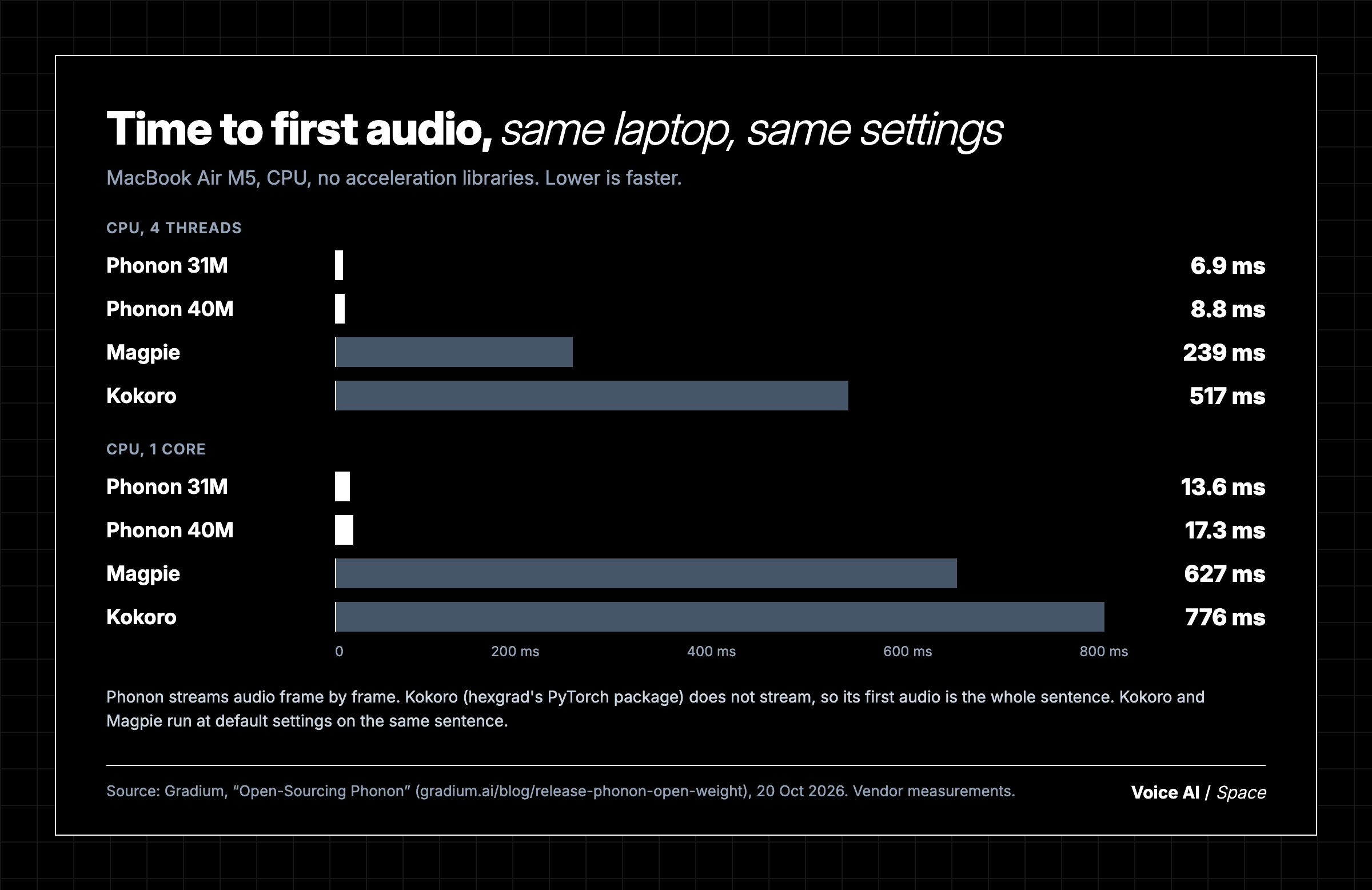
Phonon streams audio frame by frame instead of generating the whole sentence first, which keeps the time to first audio short. Kokoro does not stream, so its first audio arrives only once the whole sentence is generated. Gradium's published figures, from its announcement (one English sentence of about 5 s, median of 10 runs):
MacBook Air M5 CPU, same settings for both models (no KleidiAI): with 4 threads, Phonon 31M starts speaking in 6.9 ms and Kokoro in 517 ms. On one core, 13.6 ms against 776 ms.
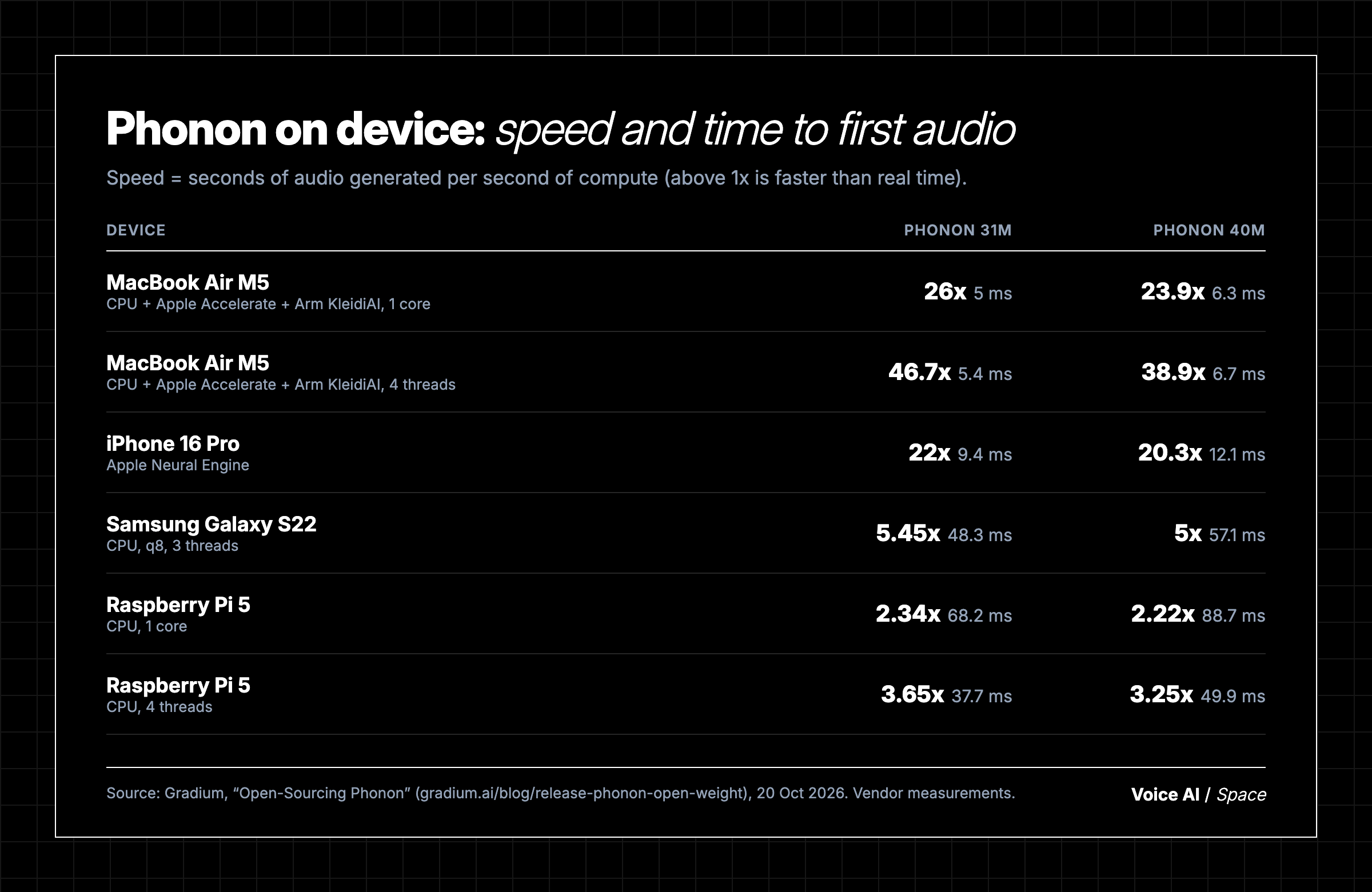
MacBook Air M5, one core with Apple Accelerate and Arm's KleidiAI library: Phonon 31M starts in 5 ms and generates audio 26x faster than real time. Phonon 40M: 6.3 ms, 23.9x.
iPhone 16 Pro, Neural Engine: 9 ms for 31M, 12 ms for 40M (GitHub README).
Raspberry Pi 5, four threads: Phonon 31M starts in 38 ms and runs 3.7x faster than real time. Kokoro needs 7 seconds to start and runs below real time. On one core, Phonon 31M starts in 68 ms at 2.3x.
Gradium also cites partner measurements: 28 ms to first audio on Arm CPUs with KleidiAI, as measured by Arm, and 7.5 ms and 24x real time on Qualcomm's Snapdragon 8 Elite Gen 5.
These figures come from Gradium and its partners. The inference code is public, so developers can reproduce the measurements on their own hardware.
Quality: what Gradium measured
Naturalness. Gradium ran blind pairwise listening tests against Kokoro, Magpie, NeuTTS and Pocket TTS in each language, with 1,189 raters and 17,270 votes. In US English, Gradium reports these Elo scores: Phonon 40M 2117, Phonon 31M 2098, Phonon 40M multilingual 2097, Pocket TTS 100M 2056, Kokoro 2043, NeuTTS 2034, Pocket TTS 15.6M 1997, Magpie 1939. Gradium reports Phonon ahead of the compared models in French, German, Spanish and Portuguese as well.
Accuracy on structured text. Gradium built a test set of 500 sentences per language (phone numbers, email addresses, postal codes) from cases developers sent in, and published it on Hugging Face. English word error rates: Phonon 31M 1.70%, Phonon 40M multilingual 2.11%, Phonon 40M 2.22%, Kokoro 3.50%, Kitten TTS 7.40%, NeuTTS Nano 8.71%, Magpie 27.51%. Gradium transcribed the audio with qwen3.8-omni-flash and had gemma-4-31b-it count the errors, an LLM-judged word error rate.
Where it comes from
Gradium was founded by researchers from Kyutai, the Paris lab behind Moshi. Phonon builds on Kyutai's work on Continuous Audio Language Models, which also produced Pocket TTS earlier this year. Gradium first announced Phonon in April and has run it in private beta since, publishing evaluation updates in April and May.
Architecture
A small causal transformer reads raw text, with no phoneme conversion step, which makes adding new languages simpler. It predicts one latent vector every 80 ms. A flow-matching head turns each vector into audio embeddings in a single step, and a smaller version of the Mimi decoder converts those into 24 kHz audio. The 31M model has 6 transformer layers and the 40M model has 9. For the older text-to-speech pipeline that Phonon moves away from (phonemes, then a spectrogram, then a vocoder), see How Text-to-Speech Works, Step by Step.
Custom voices, on device
Phonon works with voices cloned or designed in Gradium Studio or through Gradium's API. The voice file is downloaded, loaded into Phonon and runs locally. Gradium says creating voices is free and unlimited. The README states that cloning a voice requires the speaker's consent.
Use cases
Gradium and its partners point to several uses for on-device speech:
Consumer apps: accessibility features, read-aloud, language learning, and character voices in games, without a per-request cloud cost.
Environments with unreliable connectivity: Gradium's example is automotive, where voice has to run on embedded hardware, respond quickly and keep working without a network. FORVIA is a design partner on joint R&D.
Privacy-sensitive products: when speech is generated on the device, the text does not leave it.
Voice agent development: the local, OpenAI-compatible server can be used to prototype and test TTS integrations.
Phonon is available on GitHub and Hugging Face (31M English, 40M English, 40M multilingual). Gradium's announcement includes an in-browser demo.
Sources
Gradium, Phonon inference code, README, model table, licenses, performance table: https://github.com/gradium-ai/xn-ptts
Gradium, "Open-Sourcing Phonon: A Suite of Frontier On-Device TTS Models", 20 October 2026 (benchmarks, integrations, partner figures): https://gradium.ai/blog/release-phonon-open-weight
Phonon on Hugging Face: https://huggingface.co/gradium/phonon-31m-en, https://huggingface.co/gradium/phonon-40m-en, https://huggingface.co/gradium/phonon-40m-multilingual
Gradium, hard-sentences test set: https://huggingface.co/datasets/gradium/tts-hard-sentences-202610
Gradium, "Gradium Phonon: on-device TTS for consumer apps, NPCs and offline products", 3 April 2026: https://gradium.ai/blog/gradium-phonon
Gradium, "Evaluating Phonon", 9 April 2026: https://gradium.ai/blog/evaluating-phonon
Gradium, "Phonon update", 26 May 2026: https://gradium.ai/blog/phonon-update-may-2026
Kyutai, Pocket TTS: https://kyutai.org/blog/2026-01-13-pocket-tts and https://github.com/kyutai-labs/pocket-tts
Phonon on PyPI: https://pypi.org/project/ptts/
Published in partnership with Gradium.