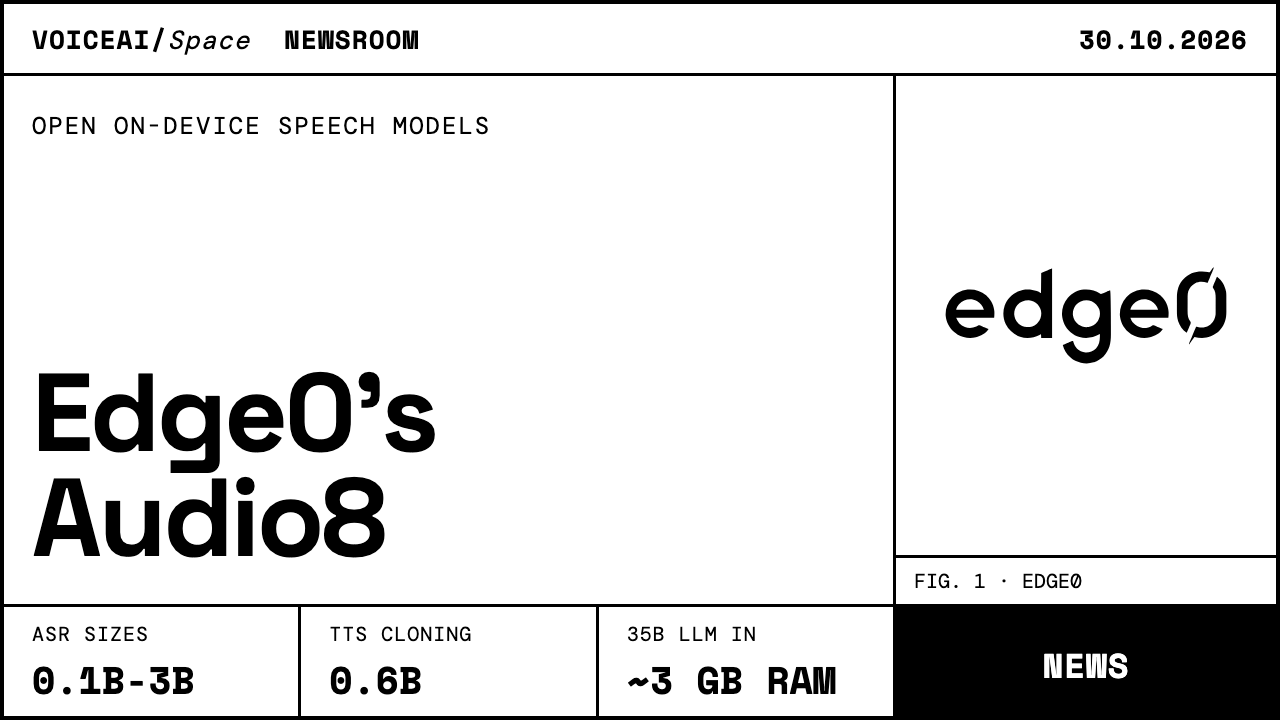
Edge0 has published a family of open on-device speech and language models built for consumer hardware: Audio8 speech recognition from 0.1B to 3B parameters, Audio8 zero-shot voice-cloning text-to-speech at 0.1B and 0.6B, and a streaming inference framework that Edge0 says runs a 35-billion-parameter language model in about 3 GB of memory. The latest release, Audio8-TTS-Realistic-0.6B, went up on Hugging Face on October 14 with 23 languages.
What: open speech-to-text, text-to-speech and language models from Edge0, sized for phones, laptops, earbuds, glasses, toys and robots.
Speech recognition: Audio8 ASR in 3B, 0.6B and 0.1B sizes, plus Audio8 ASR Infinite, a streaming Chinese and English model.
Text-to-speech: Audio8 TTS in 0.6B and 0.1B sizes, with zero-shot voice cloning from one reference recording.
Language models: Edge0-35B and Edge0-8B previews, which stream expert weights from SSD. Edge0 reports 2.9 GiB and 1.0 GiB of peak MLX allocator memory.
Licences: Apache 2.0 for most models; Audio8 ASR 0.1B is CC-BY-NC 4.0 and Audio8 TTS 0.1B Preview uses a community licence.
What is Edge0?
Edge0 builds foundation models for devices with tight memory, power and latency budgets rather than for cloud GPUs. Its pitch is inference on hardware a product already ships with: no per-call cost, offline operation, and audio that stays on the device. The company sorts hardware into three tiers, from cockpits and humanoid robots (32 GB and more) through phones and laptops (4 to 32 GB) down to earbuds, glasses and AI toys (200 MB to 4 GB of memory), and says its models reach all three. Founder and CEO Samuel Zeng holds a PhD in artificial intelligence and was named to MIT Technology Review's Innovators Under 35, according to the company's About page.
The models are on Hugging Face and the code is on GitHub. The first ARK-ASR checkpoints went up on Hugging Face in May and June 2026. On September 10, Edge0 published its Audio8 ASR overview and open-sourced the Edge0 framework, and it has added releases since.
The Edge0 model family
Model |
Task |
Size |
Runtime |
Languages |
Licence |
|---|---|---|---|---|---|
Audio8 ASR 3B (ARK-ASR-3B) |
Speech-to-text |
3B |
GPU / cloud |
19 |
Apache 2.0 |
Audio8 ASR 0.6B (ARK-ASR-0.6B) |
Speech-to-text |
0.6B |
GPU, workstation, CPU INT8 |
19 |
Apache 2.0 |
Audio8 ASR 0.1B |
Speech-to-text |
0.1B |
CPU, mobile, Apple Neural Engine |
7 |
CC-BY-NC 4.0 |
Audio8 ASR Infinite |
Streaming speech-to-text |
3B decoder + Voxtral audio tower |
GPU, vLLM |
2 |
Apache 2.0 |
Audio8 TTS Realistic 0.6B |
Text-to-speech, voice cloning |
601M |
GPU, SGLang Omni |
23 |
Apache 2.0 |
Audio8 TTS 0.1B Preview |
Text-to-speech, voice cloning |
170M |
CPU |
8 |
Audio8 Community Licence |
Audio8 TTS 0.1B ONNX INT8 |
Text-to-speech, voice cloning |
170M |
CPU, ONNX Runtime |
11 |
Apache 2.0 |
Edge0-35B-A3B (preview) |
Language model |
35B (3B active) |
MLX on Apple Silicon |
n/a |
Apache 2.0 |
Edge0-8B-A1B (preview) |
Language model |
8B (1B active) |
MLX on Apple Silicon |
n/a |
Apache 2.0 |
Sources: Edge0 model pages and Hugging Face model cards. On Hugging Face the two larger ASR models are published as ARK-ASR-3B and ARK-ASR-0.6B.
Audio8 ASR: speech recognition from cloud to phone
The three Audio8 ASR sizes target different deployments. The 3B model is the accuracy option for meetings, interviews, subtitles and mixed-language audio. The 0.6B model trades some of that for throughput and a single-GPU budget, and also ships as a CPU INT8 build. The 0.1B model runs locally through ONNX Runtime or the Apple Neural Engine, with INT8 and INT4 quantization. Its iOS build is designed for iPhone transcription with roughly 200 MB of memory, according to the model card.
The 3B and 0.6B models cover 19 languages, including Chinese, English, German, Japanese, French, Korean, Spanish and several Central and Eastern European languages. The 0.1B model covers seven, including Cantonese.
Audio8 ASR Infinite, published on September 21, is a separate streaming model for Chinese and English. It builds on Mistral's Voxtral Realtime audio encoder and a Qwen2.5-3B decoder, decodes up to 12.5 times per second, and uses a rolling 30-second KV cache so memory and latency stay flat during 24/7 transcription. It also includes a semantic VAD head that tries to tell a thinking pause from the end of a turn, a problem covered in the Voice AI Space explainer on turn-taking. It is labelled a preview.
How Audio8 ASR ranks on the Open ASR Leaderboard
Edge0 describes Audio8 ASR 3B as "world-best" with a 5.04% average WER. The ARK-ASR-3B model card explains that this figure covers the Hugging Face Open ASR Leaderboard's English short-form sets at the time (AMI, Earnings22, GigaSpeech, LibriSpeech, SPGISpeech and VoxPopuli). The leaderboard has since added test sets and two private sets to its default average. On October 30, 2026, it listed the Edge0 models as follows, next to three higher-ranked open-weight models from NVIDIA, Qwen and IBM:
Model |
Average WER (default view) |
RTFx |
Rank (of 63) |
|---|---|---|---|
NVIDIA Nemotron-3.5-Transcribe-30B-A4B |
5.33% |
462 |
9 |
Qwen3-ASR-1.7B |
5.40% |
819 |
11 |
IBM Granite Speech 5.0 2B |
5.68% |
545 |
12 |
Edge0 ARK-ASR-3B |
5.92% |
479 |
19 |
Edge0 ARK-ASR-0.6B |
5.93% |
661 |
20 |
Edge0 Audio8-ASR-0.1B |
8.29% |
719 |
51 |
Source: Open ASR Leaderboard, October 30, 2026. Lower WER is better; higher RTFx (inverse real-time factor) is faster. The rank includes closed API models. All rows use the same test sets and text normalization.
The 0.6B model scores within 0.01 points of the 3B model on this English board while running about 38% faster. The 3B model's additional parameters target multilingual, noisy and long-form audio, which the English board does not measure. For how these scores are built, see How Voice AI Benchmarks Work.
Audio8 TTS: zero-shot voice cloning at 0.6B and 0.1B
Audio8 TTS uses a two-stage DualAR design, which the model card says is inspired by Fish Audio's S2 Pro. A slow autoregressive transformer plans one semantic token per audio frame, about 21.5 frames per second, and a fast transformer fills ten acoustic codebooks for each frame. A bundled 44.1 kHz neural codec turns the codes into audio. Voice cloning takes one reference recording and its exact transcript, with no fine-tuning per speaker, and Edge0's model page says a reference in one language can drive speech in another.
Audio8-TTS-Realistic-0.6B, released on October 14, adds 12 languages to the Preview's 11, including Arabic, Hindi, Portuguese, Russian, Thai and Vietnamese. Edge0 reports a 1.25% average error rate on Seed-TTS (English WER and Chinese CER) with 0.704 speaker similarity, and 4.86% on nine CV3 languages. The model card notes that these metrics measure intelligibility and speaker similarity, not perceived realism, and that other models' figures come from different pipelines. Serving runs through an SGLang Omni adapter with an OpenAI-compatible speech endpoint. A Hugging Face playground is available.
The 0.1B model swaps the slow stage for a Falcon-H1 hybrid of attention and Mamba 2 layers, with a 170M-parameter main model. Its ONNX INT8 build runs without CUDA or PyTorch. On an 8-thread Linux x86 machine, Edge0 measured about 0.4 GiB of memory after loading, 19 ms per slow-stage token and 8 ms per frame for the fast stage. Other compact on-device TTS models covered on Voice AI Space include Gradium's Phonon and Neuphonic's NeuTTS-2E.
Edge0-35B: a 35B model Edge0 says runs in about 3 GB
Edge0's language models address the memory side of on-device AI. Mixture-of-experts models only activate a few experts per token, but every expert normally has to sit in memory. The Edge0 framework keeps the full model on SSD, holds only the active working set in RAM, and uses a trained "Prerouter" head to predict which experts the next layers will need, so it can load them before the computation reaches them.
Edge0-35B-A3B is based on Qwen3.6-35B-A3B and Edge0-8B-A1B on Ling 3.0, both in 4-bit and both published as previews. Edge0's GitHub repository reports these figures on a Mac mini M4 Pro with 24 GB:
Model |
Weights on disk |
Peak MLX allocator memory |
Decode speed |
|---|---|---|---|
Edge0-35B-A3B |
~23 GB |
2.9 GiB |
14.9 to 17.7 tokens/s |
Edge0-8B-A1B |
~4.2 GB |
1.0 GiB |
23.9 to 25.3 tokens/s |
Source: Edge0 GitHub repository, measured on short contexts. Peak memory is MLX allocator memory, not total process memory: page cache, the tokenizer and the OS come on top. Speeds depend on SSD speed, cache state and available memory.
The Python framework runs on Apple Silicon through MLX. On September 30, Edge0 open-sourced separate inference engines and apps for iOS, macOS, Android and Windows, and lists a unified framework for Q4 2026.
Deployments Edge0 lists
Edge0's site lists integrations for smart earbuds, smart glasses, a robotics chip, embodied AI kits and smart toys. Its earbuds page describes a Shokz sports-earbuds deployment in which frequent commands such as skip, pause and volume run on the device and open questions go to the cloud. Edge0 reports 95% command accuracy on an outdoor-sport noise test set, a P95 latency of 100 ms or less from end of speech to action, a 92% cut in cloud token use, and an 18 MB INT8 package. These figures come from Edge0.
What it means for teams building voice products
Most voice agent stacks send every turn to a cloud speech-to-text, LLM and TTS service. Edge0's releases cover each of those three layers with open weights that fit local hardware, and its earbuds example shows a hybrid split: frequent intents on the device, open-ended requests in the cloud. Teams comparing hosted and local options can use the Voice AI Space guides on how speech-to-text works, latency and cost per minute, and the IBM Granite Speech 5.0 article for another recent open speech-to-text release. Edge0's page is in the Voice AI Space Library.
Sources
Edge0, home page and model pages: https://edge0.ai/models
Edge0, "From on-device speech recognition to high-precision large models", September 10, 2026: https://edge0.ai/research/audio8-asr
Edge0, "Beneath the Memory Wall: Fitting 35 Billion Parameters Into a Single Phone", September 16, 2026: https://edge0.ai/research/edge0-memory-wall
Edge0, smart earbuds solution page: https://edge0.ai/solutions/smart-earbuds
Edge0, About Us: https://edge0.ai/aboutus
Hugging Face, ARK-ASR-3B model card: https://huggingface.co/Edge0/ARK-ASR-3B
Hugging Face, Audio8-ASR-0.1B model card: https://huggingface.co/Edge0/Audio8-ASR-0.1B
Hugging Face, Audio8-ASR-Infinite model card: https://huggingface.co/Edge0/Audio8-ASR-Infinite
Hugging Face, Audio8-TTS-Realistic-0.6b model card: https://huggingface.co/Edge0/Audio8-TTS-Realistic-0.6b
GitHub, Edge0 inference framework: https://github.com/Edge0-AI/Edge0
GitHub, Audio8 TTS: https://github.com/Edge0-AI/Audio8_TTS
Hugging Face, Open ASR Leaderboard (accessed October 30, 2026): https://huggingface.co/spaces/hf-audio/open_asr_leaderboard