
Echo Speaks
TTS cache for Pipecat voice agents that replays repeated phrases instead of re-synthesizing them.



About Echo Speaks
Echo Speaks: TTS Cache for Pipecat Voice Agents
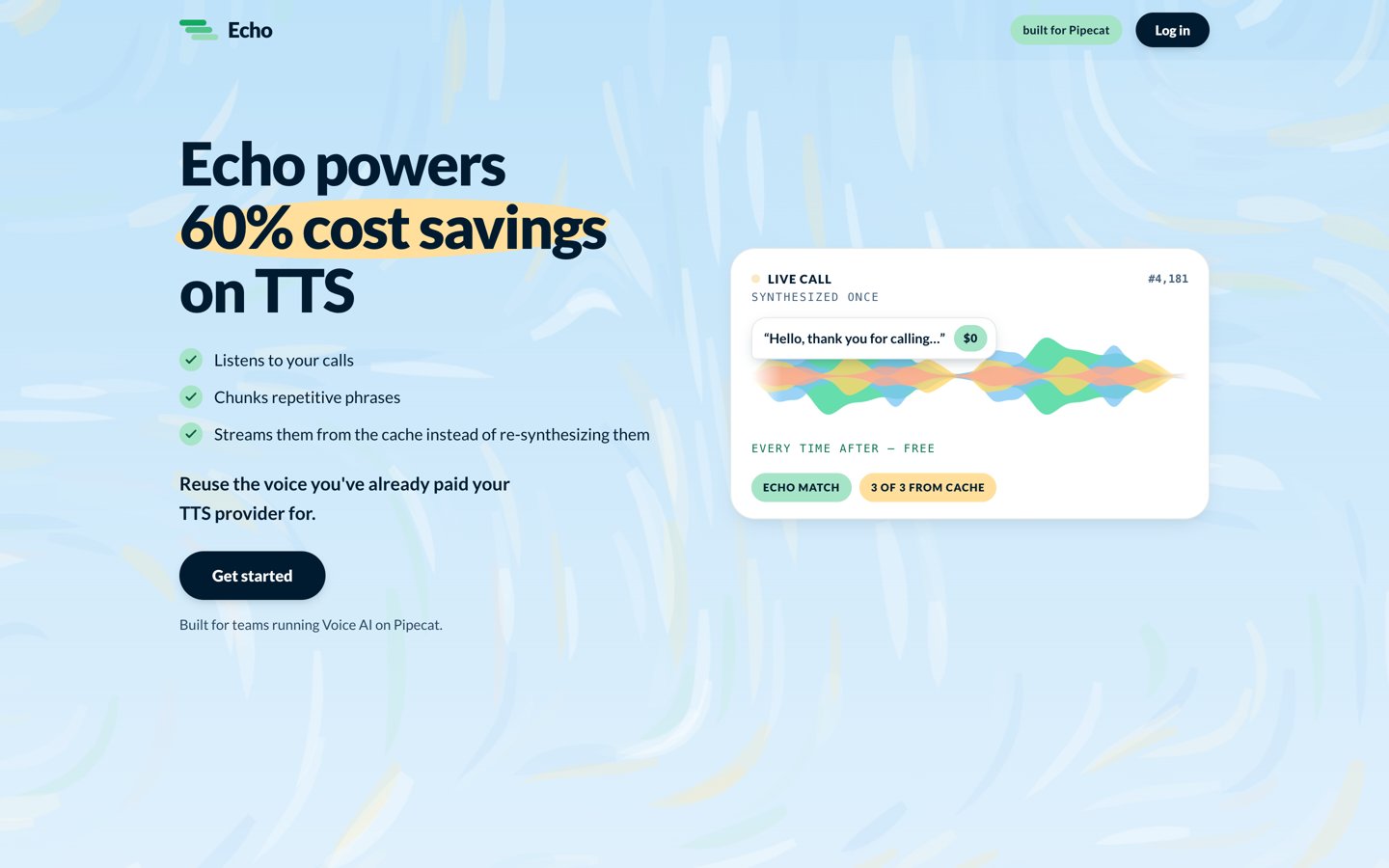
Echo is a text-to-speech cache that sits inside a Pipecat pipeline, learns the phrases a voice agent repeats on every call and streams them from cache instead of paying the TTS provider to synthesize them again. It keeps the voice and provider a team already uses, and the company says it can cut TTS costs by up to 60%.
Key Features
Drop-in Pipecat processors: Two processors wrap the existing TTS service, one before it to look up each sentence and one after it to capture new audio, with no pipeline rewrite and no new voice vendor.
Sentence-level caching: LLM output is aggregated into sentences and each one is keyed to its exact text plus the provider, voice ID, model and settings such as speed, so cached audio always matches the voice in use.
Provider agnostic: Works with the audio produced by ElevenLabs, Cartesia, Deepgram, OpenAI, Azure, Rime, Gemini, Sarvam and other TTS engines.
Fixed prompts cached whole: Utterances the app pushes directly, such as greetings and hold lines, are stored as single entries, which are often the most reused audio in a deployment.
Dynamic content stays live: Sentences with names, numbers or other call-specific details are not in the cache and go to the TTS provider as usual.
In-order playback: Cached audio is injected at the exact sentence boundary using word timestamps, so sentences play in LLM order whatever the mix of hits and misses. Interrupted audio is discarded and never stored.
Fail-open design: Each cache lookup is bounded by a 0.5 second timeout, and any error or slow response falls back to normal synthesis.
Per-call statistics: Hits, misses and a character-weighted hit rate are exposed for each call so teams can feed them into their own logs and metrics.
Regional cache servers: Cache servers run in asia-south1 and us-west1, and one API key works in every region.
Use Cases
High-volume support lines: Serve recurring greetings, confirmations and closings from cache on every inbound call.
Scripted outbound campaigns: Reuse the fixed parts of a campaign script while live synthesis handles each customer's details.
TTS cost reduction: Lower the TTS line of a voice AI stack without changing voice, model or provider.
Cache monitoring: Track hit rates per call or campaign to see how much speech is being reused.
Getting Started
Website: https://echospeaks.ai
Python package: https://pypi.org/project/echospeaks/
API key: request access through the contact form on the website.
Echo gives Pipecat teams a way to stop paying for the same sentences over and over, keeping their chosen voice while cached audio covers the parts of every call that never change.


