
nineninesix.ai
Tech
TTS
Voice Cloning
Real time
Open Source
Conversational AI
Real-time TTS API with open Gepard weights, plus Tyger, an open turn-taking model for voice agents.


About nineninesix.ai
nineninesix.ai: Real-time speech models for voice agents
nineninesix.ai builds open speech models for real-time voice agents: Gepard, a streaming text-to-speech model, and Tyger, a turn detection model that decides when an agent should speak or stop. Developers can call Gepard through a hosted API or run the open weights on their own GPUs.
Key Features
- Gepard 1.0 streaming TTS: Generates speech with under 100 ms to first audio in 15 languages, using voices trained on conversational speech rather than long-form narration.
- Three streaming modes: The API returns audio as a complete file, as Server-Sent Events, or over a persistent WebSocket for low-latency dialogue.
- Voice cloning: Clones a voice from a reference audio clip, and a LoRA or full fine-tune is possible for teams that need more control.
- Open weights: Gepard 1.0 is a 555.7M parameter model released on Hugging Face under Apache 2.0, with commercial use included.
- Runs on stock vLLM: The model was designed to be served by a standard vLLM engine without custom kernels, which keeps self-hosting simple under concurrent load.
- Cartesia-compatible API: Teams can keep the official Cartesia SDKs and point them at the nineninesix.ai base URL, and jambonz ships it as a built-in TTS vendor.
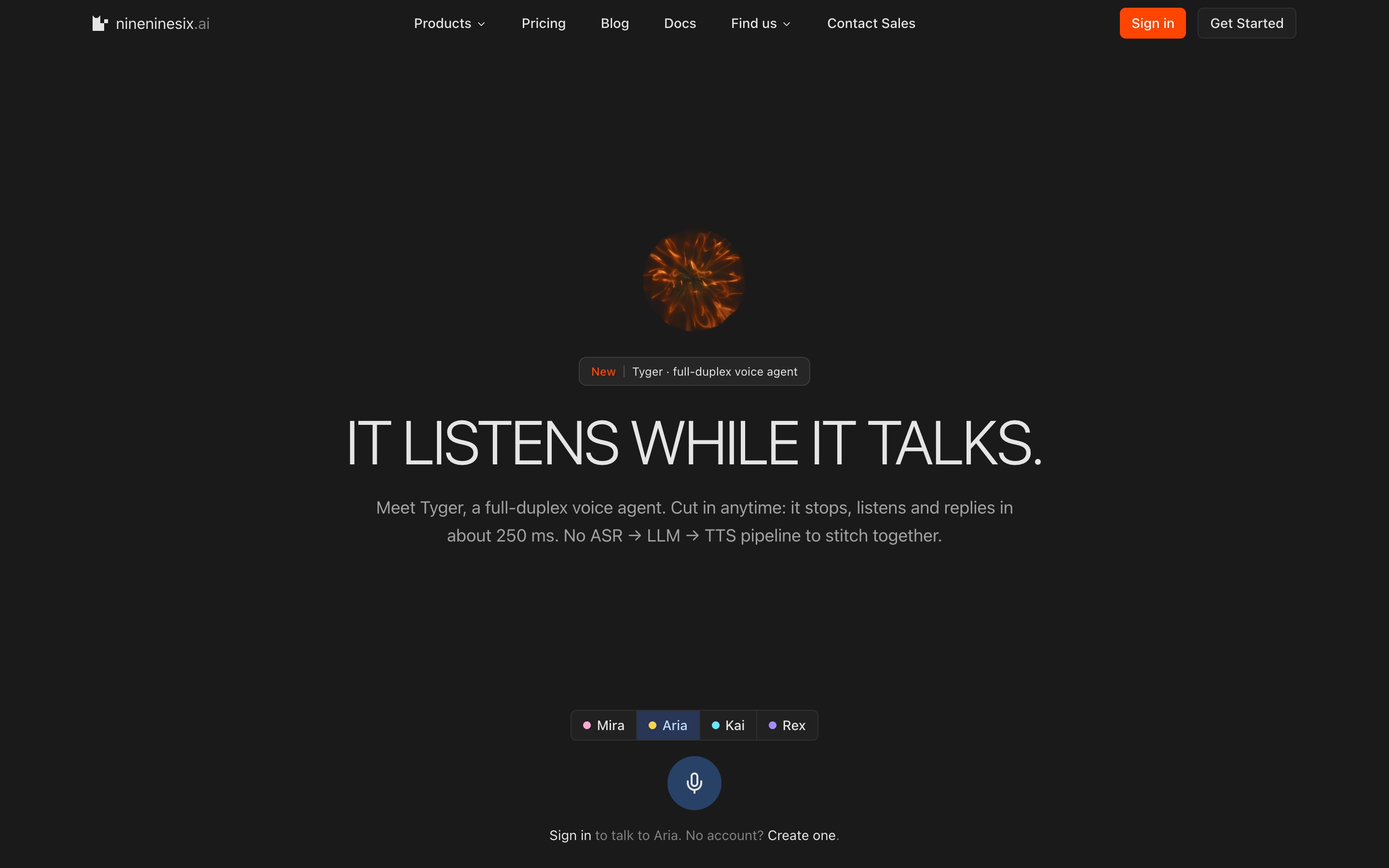
- Tyger turn detection: Every 80 ms, Tyger reads both the user's microphone and the agent's own playback and signals an endpoint, a barge-in or a moment for a short backchannel such as "mm-hm".
- Tyger-S2S agent: An open-source full-duplex voice agent built on Tyger, available as a Docker image with an API mode, that runs four concurrent conversations on a single 32 GB GPU.
- Pay-as-you-go pricing: The Gepard API is billed per character at $15 per million characters, new accounts start with 100,000 free characters, and credits do not expire.
Use Cases
- Phone and voice agents: Developers add low-latency speech output to agents running on telephony platforms such as jambonz.
- Self-hosted voice stacks: Teams with GPU capacity run Gepard or Tyger on their own infrastructure so audio stays in-house.
- Turn-taking for existing agents: Builders replace silence timers with a trained model that handles interruptions and backchannels.
- Research and prototyping: Researchers and hobbyists download the open models from Hugging Face to test, fine-tune or extend them.
Getting Started
- Website: https://www.nineninesix.ai/
- Documentation: https://docs.nineninesix.ai/
- Hugging Face: https://huggingface.co/nineninesix
- GitHub: https://github.com/nineninesix-ai
nineninesix.ai suits developers building real-time voice agents who want fast speech output and turn handling, either as an API or as open models they run themselves.


