NCSpeech
Licensed speech datasets for emerging-market languages, plus Kazakh and Russian STT and TTS.



About NCSpeech
NCSpeech: Speech Data and Speech Models for Emerging-Market Languages
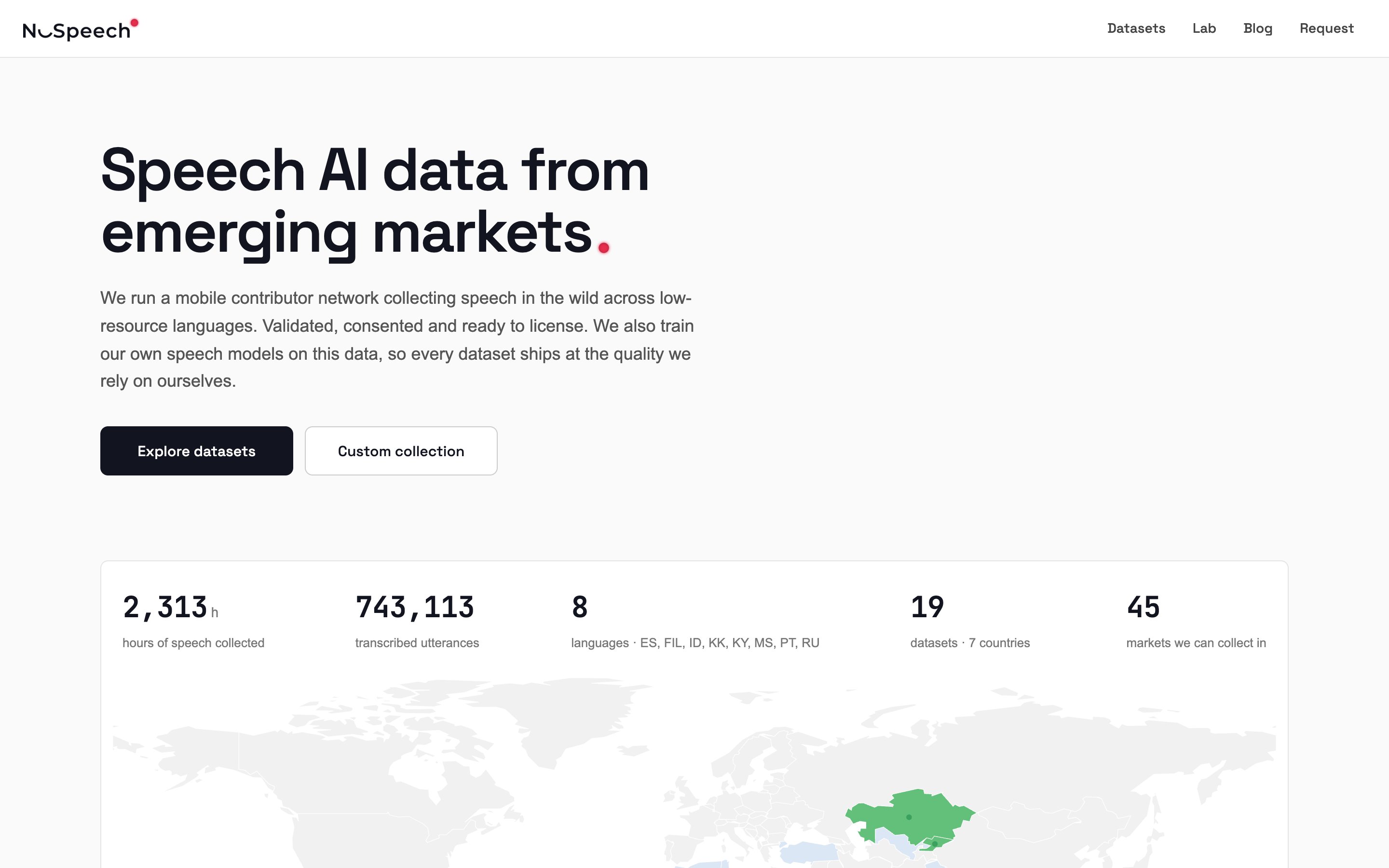
NCSpeech collects speech in low-resource languages through a mobile contributor network, then validates it and licenses it for commercial or research use. Its public catalogue holds datasets in eight languages, and the team runs custom collection. Voice Studio adds Kazakh and Russian speech-to-text and text-to-speech, built on the same data.
Key Features
Speech Dataset Catalogue: Datasets in Kazakh, Russian, Kyrgyz, Malay, Indonesian, Filipino, Spanish and Portuguese, covering banking, medical terms, names and addresses, code-switching and everyday dialogues, plus an ambient noise set.
Collected in the Wild: Contributors record on their own devices in everyday settings, so real background noise stays in. Scripted takes that do not match their prompt are rejected at validation.
Delivery and Licensing: Original WAV recordings with full metadata under a commercial or research licence. Scripted sets include the prompt text and a normalised version, and dialogues include per-channel automatic transcripts. Samples are available on request.
Custom Collection: New data in a chosen language, market or domain on request. NCSpeech supplies voice data to YTL AI Labs for ILMU and runs a data collection pilot with inDrive.
Speech to Text: Voice Studio transcribes Kazakh and Russian files of up to 30 minutes, mixed speech included, with word timings, a language tag per word and speaker separation. Results export as text, subtitles or JSON.
Streaming Recognition: A WebSocket endpoint returns final text at natural pauses, for calls, voice assistants and live subtitles.
Text to Speech: Catalogue voices speak both Kazakh and Russian, with numbers, dates and phone numbers expanded into words automatically, plus stress and pause markup.
Voice Cloning: Users can create a private voice from a short sample after confirming they have the right to use it.
Developer API: The API mirrors the OpenAI audio API, so OpenAI SDK clients work after a base URL change, and the docs are served to AI agents over MCP. A Tagalog speech recognition model is open on Hugging Face.
Use Cases
Training Speech Models: Licensing speech in under-served languages, including code-switched speech, to train and test recognition.
Call Centers: Transcribing call recordings channel by channel and voicing customer messages in Kazakh and Russian.
Media and Education: Transcribing interviews and lectures and voicing learning materials.
Product Teams: Adding Kazakh and Russian recognition and synthesis to services and apps through the API.
Pricing
Dataset pricing is on request and depends on hours, licence and delivery format. Voice Studio has a free plan, paid monthly plans billed in tenge, and an Enterprise plan on request with on-premise deployment.
Getting Started
Website: https://ncspeech.org/
Datasets: https://ncspeech.org/datasets
Voice Studio: https://studio.ncspeech.ai/
Tagalog model: https://huggingface.co/NCSpeech/stt_tl_fastconformer_hybrid_large
NCSpeech pairs a speech data business for under-served languages with its own speech models, trained on the data it collects.
Funding
$110K raised · 1 round


