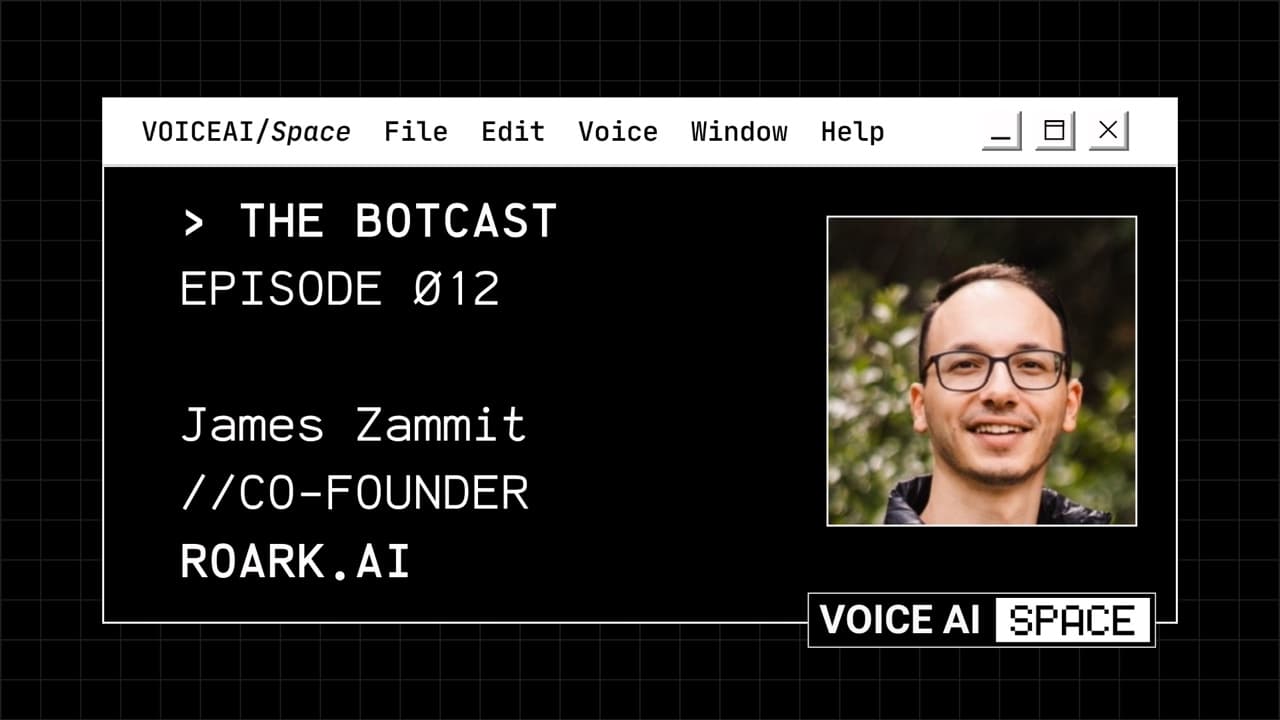
Meet Rob Pickering, Founder at Aplisay, who joined the BotCast #7 to answer our usual questions on building with Voice AI.
Who are you?
My name's Rob Pickering. I'm founder at Aplisay, and the main thing that I'm building is an open-source infrastructure which is used by numerous organizations as a baseline for their voice AI offerings. I also have a new baby, a new project called polite.ai, which is our attempt to produce a direct, end-user facing best practice portal that allows people to just sign up and start building this stuff.
How did you end up using voice AI?
Super long story, as you can tell from my gray beard. I started off building internet infrastructure in the late 80s and then went on to Voice over IP in the 2000s, had a successful Voice over IP company, and then started looking at voice AI in the 2019-2020 timeframe. It's been a progression from internet to Voice over IP to voice AI, and that's how I ended up here.
A moment of joy and pain using voice tech.
I'm going to do that as pain first and then joy afterwards, because that's the right way to do the world, right? My biggest pain in voice AI was going too early in 2019-2020, where I built a direct-to-SME, end-user AI assistant based on the Dialogflow Lex generation technology, where we were training intent recognition and I thought I could build a product that could be used as a small business telephone interface. The tech wasn't ready. I refused to believe that and just kept on building, and the market wasn't ready. So, that was my real pain point in voice AI.
My moment of joy, and it's always good to end the story on joy, was in 2023, where I came back to GPT, hooking large language models up to telephony systems. In 2023, I jumped on a stage at a Comms industry conference, and I shared a very early demo of an entire voice pipeline pulling voice AI on the telephone, and looked at the astonished audience, and their eyes light up at the possibilities of this. And I knew right at that very moment that large language models were going to really propel voice AI in exactly the way that they have. And that was definitely a moment of joy at that point.
What lesson would you share with other builders?
Validate your market early, unless your technology is just incredibly revolutionary. The chances are, if your market doesn't grab it with both hands and tell you it's ready, you haven't really got a market. Get really early versions, MVPs, betas, out in the market, get it tested, find a vertical, concentrate on somewhere that the product really works, and build your way out of there. If you are getting hundreds of millions of VC rounds, then you can build something for the five-year intercept, but if you're not building something that you can see how it works today, then you're going to have a tough time.
Where do you see the industry in 12 months and in 5 years?
Right now we're building two kinds of voice AI. We're using the kind of voice AI that we use on agents that work for us, and the reason that we do that within those agents is because we tend to think at the speed we can talk. We want an audio interface on agents because it allows us to talk very quickly to an agent and we can hold that thought. When we type, it breaks the thought. That was the kind of agentic AI voice. I'm not going to dwell on that because that's largely owned by the agent and the foundation technology industry.
And then, the other place we're using it is as a call center or human agent replacement technology bolted onto the side of organizations in the way that we bolt telephone answering onto the side of organizations. I think what we're going to see is a migration of that to highly sophisticated agents working in teams. At the 12-month point, and this is where we're trying to build with polite.ai, I see that as just more intelligent agents on the side of organizations that can respond properly, can bring humans in when it's appropriate, and can deal with all the knowledge base in the organization. So, the 12-month picture is incrementally better.
By the time we get out to 5 years, I think what we start to see then is entirely different metaphors for the way that we do voice and video avatar interfaces on organizations, and that's going to go far more towards the agent being a true interface on the organization that can see all of the data in the organization, that can see all the business models in the organization, and can operate, if not autonomously, in concert with a group of human agents to deliver an absolutely breathtaking interface experience on that organization. If we do it right, that's what year 5 looks like.