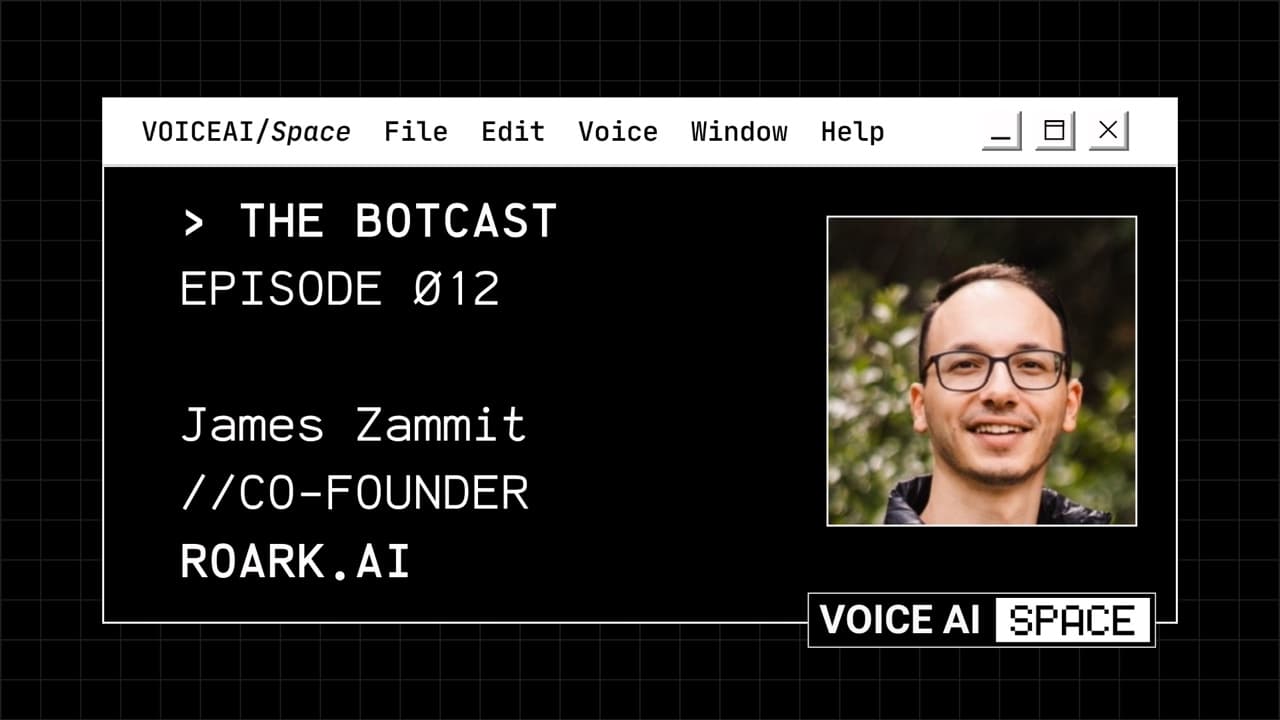
Florent’s journey into voice was not exactly planned. He worked in telecoms, software, data, and cloud infrastructure before realizing that voice AI brought all those worlds together.
For him, the hardest part is making complex technology feel simple, fast, and natural. The best part is seeing it solve a real problem for a customer. He believes voice AI will become easier to build, native audio models will take over, and talking to technology will soon feel normal again.
That realization became fluent.
We asked Florent our usual three questions.
How did you end up in voice?
I started my career in Europe working in networking, telecommunications, and security. I acted as a forward-deployed engineer (before it existed), managing and configuring Cisco CallManager deployments across various data centers. Wanting to expand my horizons, I transitioned from pure infrastructure into software, specifically focusing on big data and business intelligence. My company was eventually acquired by Zendesk, which brought me to San Francisco. This led to an incredible eight-year tenure helping build Google Cloud. While Google was phenomenal, my ultimate goal in the US was always to launch my own company. After a brief stint at Vocode, I realized that real-time Voice AI was the perfect convergence of my entire background. Today, I am combining my deep expertise in VoIP applications with my passion for solving complex infrastructure challenges to build my own startup.
What's your struggle or moment of joy with voice?
While the infrastructure behind real-time Voice AI is incredibly demanding, my true joy doesn't come just from building the technology; it comes from the customer. My main focus now, as it has been throughout my entire career, is rolling up my sleeves and working directly with clients on practical, real-world use cases. Voice is the most intuitive interface we have. There is something deeply rewarding about taking highly complex backend infrastructure and transforming it into a seamless, natural conversation. Building the tech is the challenge, but seeing it instantly solve a massive operational bottleneck for a customer... That is the joy.
Where do you think voice is going?
1. Chained architectures will eventually disappear. Native audio-to-audio models are the new standard, becoming increasingly domain-specific, lightweight, and blazingly fast.
2. While adoption feels slow today due to deployment friction, tooling and cost curves are improving exponentially. Voice AI will soon transition from a novelty channel to core enterprise infrastructure.
3. I am incredibly bullish that voice will reclaim its position as the default human-machine interface. We’re already seeing developers "vibe coding," and this will scale to everything from embedded systems to automated checkouts.